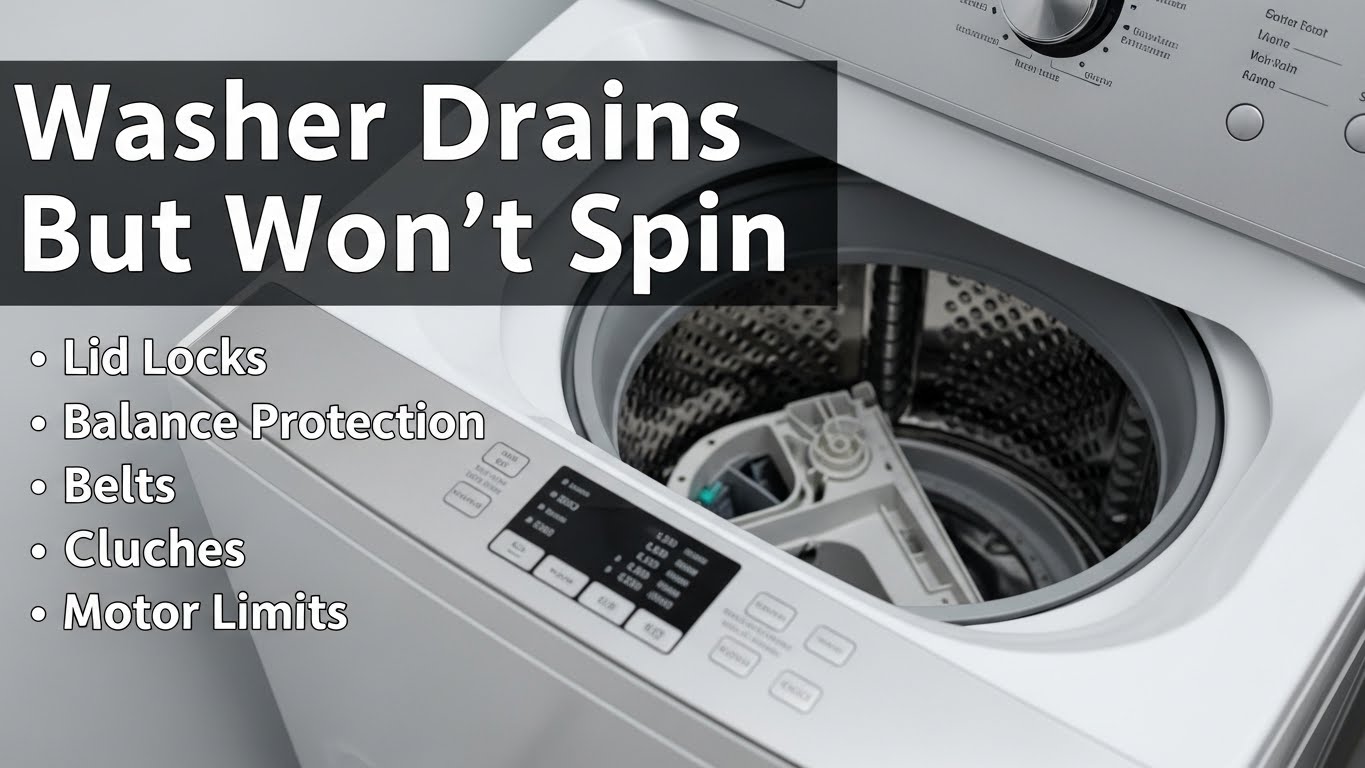
Washer drains but won’t spin? Use the “Silence vs. Sound” + “Empty vs. Towel” tests to pinpoint the real failure.
If the washer drains but the laundry is still heavy and wet, your pump did at least part of its job. Spin stops for four main reasons: (1) permission/lock (lid/door lock feedback), (2) balance protection (unbalance, leveling, suspension), (3) drive engagement (belt, clutch/splutch, coupler, actuator), or (4) motor/control limits (can’t reach speed safely, stops under load). This guide is designed so you can diagnose the right bucket before buying parts.
Fast-Track: Do these 2 tests first
- Empty Spin Test: Run “Spin Only” with no clothes. If it spins fast when empty, the motor/control can work.
- Towel Micro-Load Test: Add 2–3 towels. If it fails only under load, suspect balance/suspension or clutch/engagement slip, not a dead motor.
- Silence vs. Sound: No real attempt after drain → permission/lock or balance logic. Motor sound but tub won’t move → drive engagement.
⚠️ Safety warning (spin diagnosis crosses the “moving parts” line)
- Unplug first before tilting, removing panels, or reaching near the motor/belt.
- Never bypass a lid/door lock to “force spin” (serious injury risk + damage risk).
- Stop immediately if you smell burning rubber/electrical odor, see sparking/arcing, or the outlet/plug feels hot.
- Do not keep retrying high-spin when it fails—repeated attempts can overheat components and turn a small failure into a big one.
Updated: 2026-01-19 • One-page deep guide • Built for “I need the real cause, not guesses”
This is one of the most common “finish line” failures: the washer washes, rinses, and drains… then refuses to spin. That’s not random. The spin cycle is the riskiest phase (fast moving parts + vibration + water weight), so modern washers won’t spin just because you selected it—they spin only after a safety checklist passes.
Your job is to figure out which bucket you’re in: permission → balance → engagement → speed. If you follow the order below, you’ll stop guessing and you’ll also know where the smart DIY stop-line is.
The “Spin Permission” logic (how the washer decides)
Think of spin like a pilot’s pre-flight checklist. The control asks: “Did water leave fast enough? Is the lid/door locked? Is the load stable enough? Can the motor reach target speed?” If any answer is “no,” the washer may drain and then refuse to spin—or it may attempt to spin and abort quickly.
A simple “chain of command” model
| What you notice | Most likely bucket | Tell-tale clue |
|---|---|---|
| Dead silence after drain | Permission/lock or balance logic | Lock indicator flashes / no clear lock “click” / repeated redistributing |
| Motor hums/runs but tub won’t move | Drive engagement | Belt slip smell, rubber dust, actuator/coupler failure, tub barely turns |
| Loud banging / washer “walks” | Balance protection / suspension | Tub hits sides, never ramps to high spin, keeps trying to rebalance |
| Weak/slow spin; clothes damp not soaking | Speed limits / clutch slip / motor protection | Stops under load, overheating odor, can’t maintain RPM |
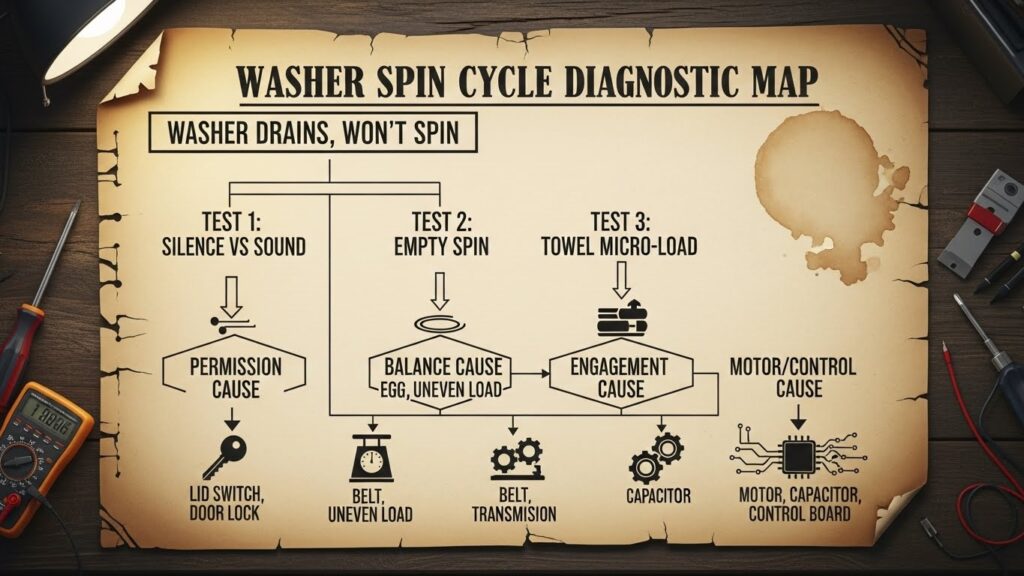
The 7-step diagnostic protocol (fast, no-tools first)
- Step 1 — Empty Spin Test (the truth-teller):
Remove all clothes. Run “Spin Only.”
Meaning: If it spins normally when empty, your motor/control can at least operate. Your failure is likely balance or engagement under load. - Step 2 — Towel Micro-Load Test (load sensitivity):
Add 2–3 towels (not one shirt, not one small item). Run spin again.
Meaning: If empty works but towels fail, suspect suspension/leveling or clutch/drive slip. - Step 3 — Confirm “spin permission” (lid/door lock behavior):
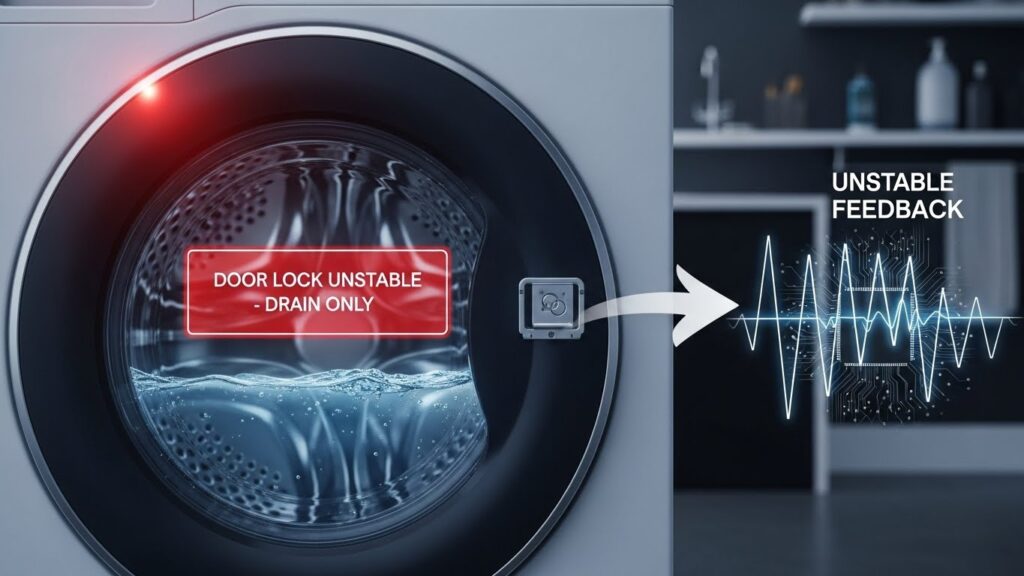
Watch the lock indicator. Listen for a solid lock click. Check that the door/lid closes without flexing or misalignment.
Meaning: Unstable lock feedback can cause “drain then stop” with no real spin attempt. - Step 4 — Drains vs drains well (the hidden trap):
Clothes can be soaked if the washer drained “some” water but not enough to pass safety checks. Look for standing water in the tub bottom.
Meaning: If water remains, the washer may forbid high spin to prevent overflow or imbalance. - Step 5 — Silence vs. sound (your biggest shortcut):
After drain, does the washer try to spin?
Meaning: No attempt → permission/balance logic. Motor sound but no tub movement → engagement failure. - Step 6 — Visual clues (no disassembly yet):
Burning rubber smell, black dust under the unit, or repeated squealing points toward belt/clutch slip. Heavy banging points toward suspension/unbalance. - Step 7 — Error code / indicator check (don’t ignore it):
Many washers show unbalance/lock/speed sensor codes or lights. Treat those as the machine’s own diagnosis path and follow that branch.
Quick fork in the road
Empty spins fine → think load/balance or clutch slip.
No real spin attempt → think lid/door lock feedback or balance protection.
Motor runs but tub doesn’t → think belt/coupler/actuator/clutch engagement.
Top-load note (common “engagement” failure category)
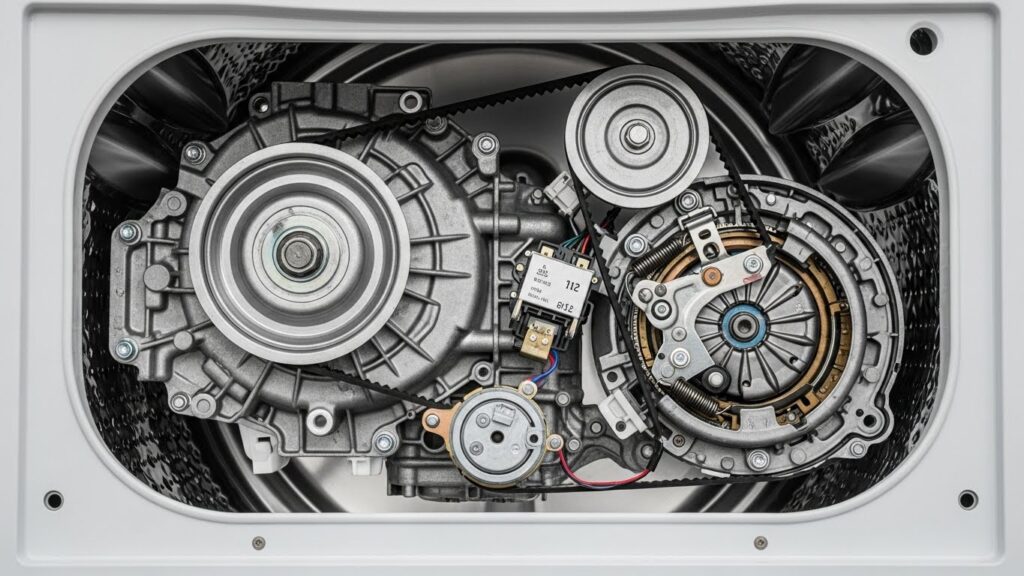
Many top-load designs fail at the “shift/engagement” step—meaning the motor can run, but the washer doesn’t fully shift into spin mode or can’t transfer torque. If you hear motor activity but the tub never reaches speed, “engagement” is your most likely bucket.
Diagnostic matrix (symptoms → most likely cause)
| Symptom | Top suspect | Best next check | Avoid this |
|---|---|---|---|
| Drains, then stops with no real spin attempt | Permission/lock feedback | Watch lock indicator + listen for lock click + confirm alignment | Buying a belt first |
| Empty spins, towels fail | Suspension/leveling or clutch slip | Leveling + tub bounce check (should settle quickly) | Assuming “dead motor” |
| Motor runs, tub barely turns / slips | Drive engagement (belt/coupler/actuator/clutch) | Look for rubber dust/smell; inspect accessible drive path only if safe | Repeating high-spin cycles |
| Loud banging, keeps redistributing | Unbalance protection / worn suspension | Micro-load test + leveling + load type (heavy single items) | Adding random items “to balance” |
| Clothes extremely wet + standing water remains | Partial drain restriction | Treat drain as the root problem first | Assuming “drains = perfect drain” |
Troubleshooting timeline (fast checks first)
| Check | Time | Tools | What you learn |
|---|---|---|---|
| Empty spin test | 5–8 min | None | Proves whether it can reach high spin with no load |
| Towel micro-load test | 6–10 min | None | Shows load-sensitivity (balance vs clutch slip) |
| Lid/door lock behavior | 3–6 min | Flashlight | Confirms permission pathway |
| Drain reality check | 6–12 min | Towel | Rules out partial drain problems that block spin |
Critical DIY mistakes (these waste money fast)
- Skipping empty spin: If you don’t prove empty spin first, you can mislabel a balance problem as a motor failure.
- Using tiny “micro-loads” like 1–2 small items: Some washers can’t balance very small loads; use 2–3 towels for the towel test.
- Assuming “it drains” means “drain is perfect”: partial drain issues can still block spin as a safety measure.
- Chasing parts before permission checks: if the washer never “allowed” spin, a new belt won’t fix it.
- Retrying high-spin repeatedly: overheating turns minor slip into damaged components.
If you’re stuck, always return to the two fastest truths: empty spin, then towel test.
High-alert stop line (call a pro)
Unplug and stop if you notice: burning electrical smell, visible sparking/arcing, a hot plug/outlet, repeated breaker/GFCI trips, or loud metal-on-metal grinding. Those are safety signals, not troubleshooting steps. If the door is locked with water inside, do not force it—follow your model’s manual release procedure or get service help.
FAQ
Why does my washer drain but not spin?
Because spin requires more “permission” than drain. The washer may drain but refuse spin if it detects an unbalanced load, unstable lid/door lock feedback, leftover water, or a drive system that can’t safely reach speed.
What does it mean if it spins empty but fails with towels?
That’s a classic “under load” failure. It usually points to balance/suspension or clutch/drive slip, not a dead motor. Level the washer, avoid heavy single-item loads, and pay attention to banging/walking.
Can a lid/door lock issue stop spin even if the door looks closed?
Yes. Many washers require stable lock feedback throughout spin ramp-up. If the lock signal is unstable, the control can drain and stop without a real spin attempt.
My washer makes a humming sound and then stops—what should I do?
A brief hum then stop can indicate motor protection, overload, or control stop. Don’t keep retrying high spin. If there’s any burning smell or heat at the plug/outlet, unplug and consider professional diagnosis.
Is this usually a clutch problem?
On many top-load designs, clutch/splutch/belt engagement is a common failure category—especially if you hear motor activity but the tub doesn’t reach speed. But always rule out unbalance and lock/permission first, because they can mimic “broken parts.”
Can I reset my washer to fix a spin issue?
A basic reset can help clear temporary logic states: unplug for a few minutes, then restart and try the empty spin test again. If the washer repeatedly refuses spin with clear lock/unbalance indicators, treat that as a real diagnostic clue rather than forcing repeated resets.
Is it worth fixing a washer that won’t spin?
Simple fixes (load/leveling, lock assemblies, basic engagement parts) are often worth it. Major failures (control boards, transmission-level repairs) can be cost-heavy depending on age and model. Use this guide to avoid replacing expensive parts without proof.
Internal Links
- Washer Not Draining — Causes and a Safe Step-by-Step Fix — If drain is partial, spin may be blocked as a safety rule
- Washer Shaking or Vibrating — Leveling and Load Fixes — Unbalance protection is a top reason spin never ramps up
- Laundry Comes Out Damp — When Spin Is Weak (Not Zero) — Helps you separate “no spin” from “low spin speed” cases
References
- Whirlpool: Reasons a washing machine is not spinning
- LG Support: Troubleshooting a washer drum not spinning
Safety notice
This guide is informational and focuses on safe, non-invasive checks. If you notice burning smell, sparking/arcing, water near electrical areas, a hot plug/outlet, repeated breaker/GFCI trips, or any shock/tingle sensation, unplug the washer and consult a qualified technician.

I publish step-by-step troubleshooting guides for common home appliance issues (washer, dryer, refrigerator, HVAC basics).
Content is written for everyday homeowners and cross-checked with manufacturer manuals, safety guidance, and trusted public resources.
Posts include practical checks, clear stop-signs for safety, and guidance on when it’s better to call a qualified technician. Updates are logged whenever steps or recommendations change.
Safety note: If you smell gas, see burning, or suspect electrical hazards—stop immediately and contact a qualified professional.