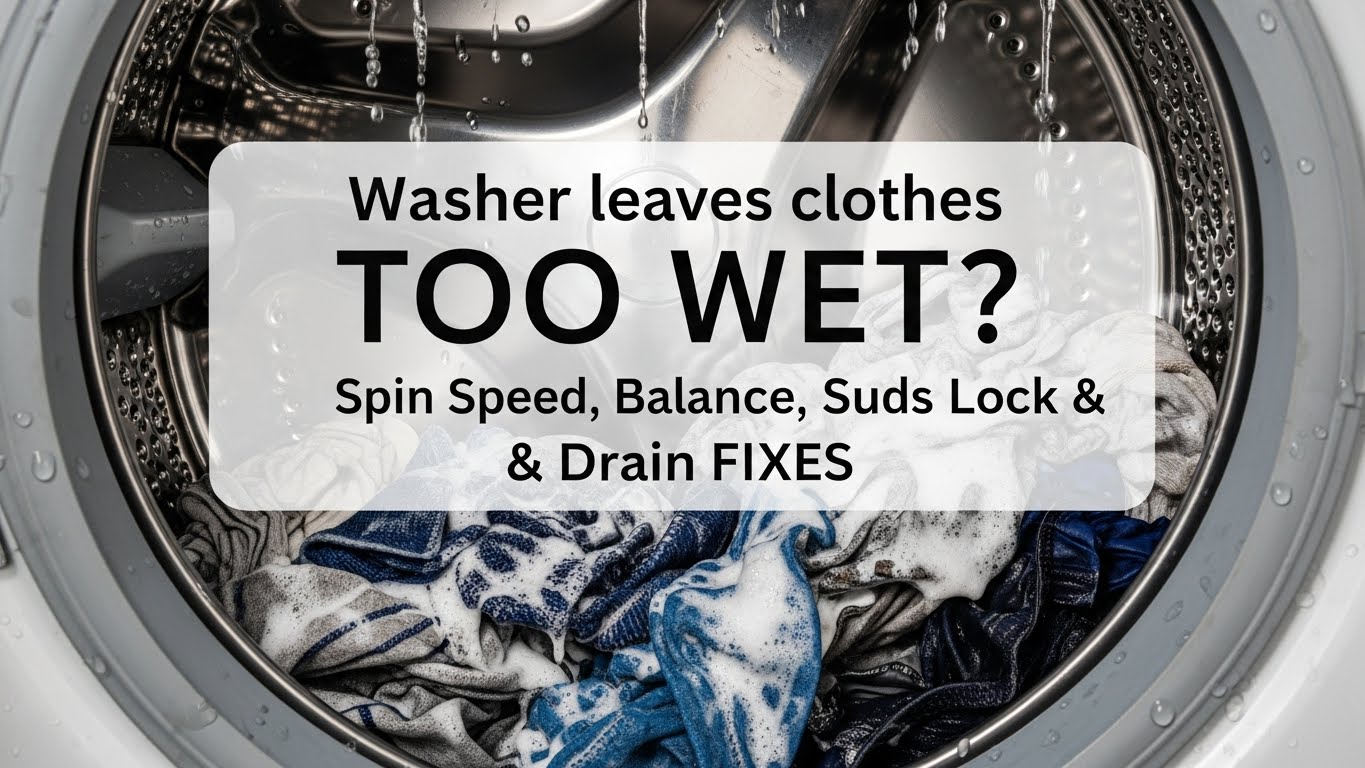
Washer leaves clothes too wet? Most of the time it’s “spin protection logic,” not a dead motor or a “bad washer.”
When laundry comes out heavy and drippy, the washer is usually blocking high-speed spin because it detected (1) load imbalance/vibration, (2) oversudsing (“suds lock”), or (3) drain flow limitation. This page is built like a tech’s checklist: fastest checks first, so you don’t waste money swapping random parts.
5-minute “Is hardware OK?” testRun Drain/Spin with High spin and an empty tub.
Most overlooked causeToo much HE detergent can stop strong spin even when it “looks clean.”
What you’ll know by the endIs it spin-limited, drain-limited, or both—and what to do next.
One-page outcome
- Separate “safe-stopping” from a true mechanical failure.
- Use a priority protocol (settings → balance → suds → drain → mechanical) that saves time.
- Make a clean repair vs replace decision with realistic cost ranges.
⚠️ Safety first (water + electricity + high-speed spin)
- Unplug before opening filter traps or touching anything near wiring/panels.
- Never bypass the lid/door lock to “watch the spin.” High RPM is injury risk.
- Stop immediately if you smell burning, hear grinding metal, or see water leaking under the unit.
Updated: 2026-01-21 • Field-tested troubleshooting • Brand notes + clear DIY limits
I’ve seen the same pattern a lot: the washer “finishes,” the clothes are heavy, and the first instinct is “pump is bad.” But after one careful run, you notice the washer never holds a strong final spin—it keeps backing off because it’s detecting wobble, foam, or a drain restriction. The good news? Those fixes are usually cheaper than people think.
Quick diagnosis: are you spin-limited or drain-limited?
Before you touch anything, answer this one question: Did the washer remove water fast enough? “Wet clothes” can happen with a perfectly draining washer (spin was limited), or with a washer that can’t move water out (drain is restricted).
The 60-second check
- If the tub is mostly empty but clothes are heavy → likely spin didn’t reach full speed.
- If water is pooled or drain sounds weak/slow → start with drain path.
- If you see foam after draining → treat as oversudsing until proven otherwise.
How a washer removes water (and why it sometimes “quits”)
Water extraction happens mostly during the final spin. The faster the basket spins, the more water gets pushed out through tiny openings. But modern washers won’t ramp to top speed unless the machine believes it’s stable and the water can exit fast enough. If it senses wobble, too much foam, or slow draining, it often reduces spin to protect the tub, bearings, and floor.
Tiny physics (plain version)
Faster spin = stronger outward force on water. $$F \approx m \cdot r \cdot \omega^2$$ If the washer can’t safely increase ω (spin speed), your clothes stay wet—even if the washer “completed.”
Brand-specific spin logic (what’s “normal” for your washer)
Different brands protect against imbalance differently. Knowing the “personality” of your washer helps you troubleshoot faster.
- Samsung (VRT/VRT Plus): Very sensitive to vibration. It may spend a long time rebalancing, then end with wet clothes. If you see Ub/UE, treat it as balance first.
- LG (TrueBalance/AI DD): Often caps RPM quietly (especially with rugs/blankets). You may get damp-heavy laundry without a dramatic error code.
- Whirlpool/Maytag (many top-loaders): If you hear repetitive “clicking” before spin, it can be a shift/actuator issue—but confirm settings, load, suds, and drain first.
Priority Fix Protocol (do these in order)
This order matters. Each step tells you something. If you skip ahead, you’ll end up “fixing” the wrong problem.
- Step 1 — Run the empty-tub Drain/Spin test (the fastest truth test):
Run Drain/Spin with High spin and no laundry.
- If it hits a high-pitched “roar” and ends with no standing water → hardware is likely OK. Move to balance/suds.
- If it never ramps up, makes abnormal noises, or stops repeatedly → treat it as a deeper issue (but still check suds/drain next).
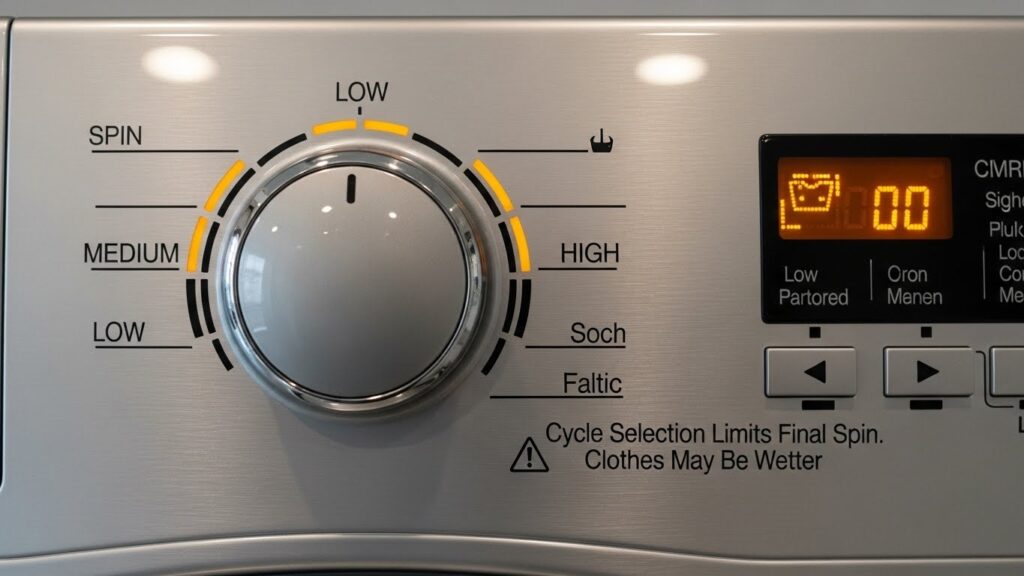
- Step 2 — Confirm cycle + spin setting (you might be “asking it to spin gently”):
Many cycles reduce final spin by design (delicate, bulky, “eco,” some bedding settings). If the fabric allows, select a higher spin. If your washer allows it, add a separate Drain/Spin after the cycle as a test.
Common “oops”Custom cycle saved with Low Spin or No Spin, then reused for weeks. - Step 3 — Fix load balance like a tech (not like a guessing game):
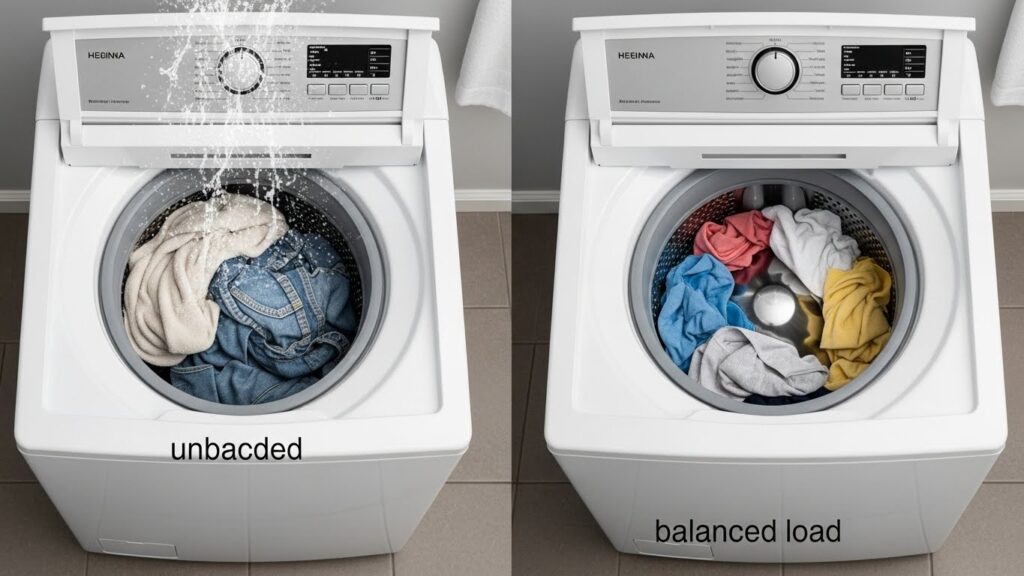
Wet laundry becomes heavy and can clump into a “one-sided bowling ball.” The washer senses wobble and backs off the RPMs.- One heavy item + light items (hoodie + shirts, bath mat + tees) is the worst mix.
- For bulky items, add 2–3 similar-weight towels (not random extra clothes) to help even distribution.
- If it keeps doing “try → stop → try” before the final spin, that’s classic balance protection behavior.
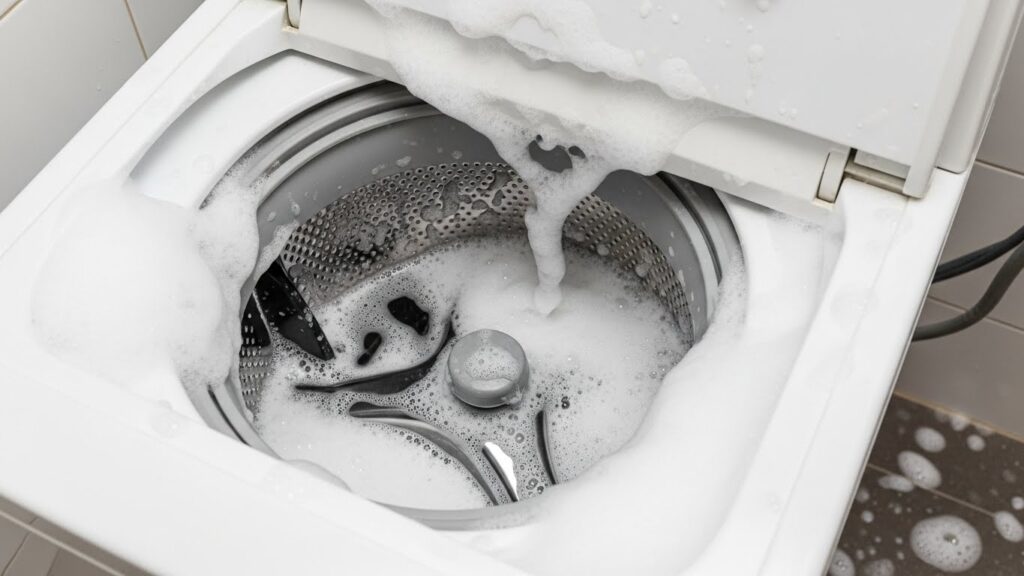
- Step 4 — Eliminate oversudsing (“suds lock”) before blaming motors:
Too much detergent makes foam. Foam contains air, and air interferes with pumping and stable spinning. Some washers reduce spin to avoid a foam-driven mess.- If you see foam after draining, run Rinse/Spin or an extra rinse with no detergent.
- Soft water often needs less detergent than the cap suggests (this is where “invisible oversudsing” happens).
- Step 5 — Confirm drain flow isn’t limiting extraction:
Even if the tub looks “mostly empty,” a partial restriction can cause water to slosh back during spin or prevent full ramp-up.- Check drain hose for kinks and the standpipe height (too high can strain the pump on some installs).
- If your model has a filter/pump trap, clean it safely (towels + shallow pan ready).
- If draining sounds weak/slow, fix drain first—spin performance often “magically” improves after.
- Step 6 — Only now consider a mechanical drive problem:
If settings, balance, suds, and drain are confirmed—but the washer still can’t reach a strong spin even with a small balanced load, it may be mechanical. That’s the point to consult service, because disassembly varies by model and can become unsafe fast.
If you’re going deeper: the “no-regret” toolkit
You don’t need a full shop. These basics prevent stripped screws, water messes, and wasted time.
- Wet/dry shop vac or turkey baster + towels: for controlled water removal before opening a trap.
- Nut drivers (1/4″, 5/16″) + screwdriver set: common panel fasteners.
- Flashlight + gloves: lint and sharp edges are real.
- Phone camera notes: record noises, error codes, and a 10-second clip of the “try-stop-try” behavior.
Failure matrix: symptom → likely cause → best first move
| What you see | Most likely cause | Do this first | DIY risk |
|---|---|---|---|
| Wet after Delicate/Bulky cycle | Spin capped by design | Raise spin / add Drain-Spin test | Low |
| Thumping + repeated spin attempts | Imbalance / vibration protection | Re-sort to similar weights, reduce one bulky item | Low |
| Foam visible after draining | Oversudsing (“suds lock” behavior) | Extra rinse, reduce detergent, measure dose | Low |
| Slow drain sound + damp musty smell | Partial drain restriction | Hose kink + filter/trap cleaning (if accessible) | Medium |
| Grinding / burning smell / never reaches speed | Mechanical or electrical fault | Unplug, document symptoms, consult service | High |
Timing plan: what to do first when you’re busy
| Time you have | Best action | What it confirms |
|---|---|---|
| 5 minutes | Check spin setting + run Drain/Spin test | Settings vs hardware direction |
| 10–15 minutes | Rebalance load + remove one bulky item | Vibration/imbalance protection |
| 20–30 minutes | Extra rinse (no soap) to clear suds lock | Foam-driven weak spin |
| 45–60 minutes | Drain path inspection (hose + trap/filter) | Flow restriction that blocks extraction |
Repair vs replace (a calm way to decide)
If the fix is a setting/balance/suds/drain cleanout, it’s almost always worth it. If it’s a main control board or a major mechanical teardown, you want a simple rule: if repair approaches ~50% of a comparable replacement cost, think replacement—especially on older units. (Costs vary a lot by region and model, but the decision pattern is surprisingly consistent.)
| Typical item | DIY parts cost (often) | How to think about it |
|---|---|---|
| Drain pump (some models) | $35–$65 | Usually fix. High ROI if drain is truly weak. |
| Door latch / lock | $25–$80 | Usually fix. Common, often straightforward. |
| Main board / control | $250+ | Consider replace if the washer is older or has other wear. |
Common mistakes that keep clothes wet
- Assuming “wet = broken”: many times it’s just low spin settings or protection logic.
- Mixing one heavy item with light items: worst-case imbalance pattern.
- Overdosing detergent: foam can quietly block strong final spin and lengthen cycles.
- Ignoring drain sound quality: slow draining can masquerade as a “spin” issue.
- Re-running full cycles repeatedly: wastes time and can heat-stress components—use the protocol instead.
When to stop DIY and call service
Unplug and call service if you hear grinding metal, smell electrical burning, see repeated error codes that return immediately, or the washer can’t reach a strong spin even with a small, balanced load. Those signs can point to mechanical or electrical faults that aren’t safe to troubleshoot without model-specific procedures.
FAQ
Why are clothes still wet even though the washer “finished”?
Many washers can complete a cycle even if the final spin was reduced for balance, suds, or drain reasons. The timer ends—but extraction wasn’t strong. That’s why the empty-tub Drain/Spin test is so useful.
What’s the fastest test to confirm a spin-limited problem?
Run Drain/Spin with the highest safe spin. If you get a strong ramp-up and better extraction, the issue is often settings, balance, or suds—not a failed motor.
How do I know if it’s oversudsing if I don’t see huge foam?
Soft water + “a little extra detergent” can create persistent micro-foam that you don’t notice until it affects spinning. If cycles run long, rinses repeat, or clothes come out heavy without pooled water, do one extra rinse with no soap and re-test.
Why does the washer keep trying to spin and then stopping?
That’s usually the balance system working. Rebalance the load, remove one bulky item, and try again with similar-weight items distributed evenly.
Does cold water make clothes feel wetter?
Cold fabric can feel wetter to the touch. But if items are heavy and dripping, focus on extraction (spin/drain), not temperature alone.
If I’m calling service, what info helps them diagnose faster?
Share the exact symptom (pooled water vs just heavy laundry), any error code, and whether the empty-tub Drain/Spin test ramps to high speed. A 10-second video of the “try-stop-try” behavior is surprisingly helpful.
Internal Links
- https://homefixatlas.com/laundry-comes-out-damp — When clothes feel damp: dryer sensor, airflow, and end-of-cycle checks
- https://homefixatlas.com/washer-shaking-or-vibrating/ — Leveling and suspension fixes that help the washer reach full spin safely
- https://homefixatlas.com/washer-not-draining/ — Drain-path troubleshooting if wet clothes are paired with slow draining or standing water
Sources & References
- https://www.lg.com/us/support/help-library/lg-washer-troubleshooting-washer-does-not-drain-or-spin–1337717767769
- https://products.geappliances.com/appliance/gea-support-search-content?contentId=19289
Professional disclaimer
This guide is informational and focuses on safe, non-invasive troubleshooting. If you suspect electrical faults, persistent error codes, burning smell, leaking water, or unstable high-speed spinning, unplug the washer and consult a qualified technician.
Update log: 2026-01-21 — Upgraded to a tech-style decision flow (spin-limited vs drain-limited), expanded suds-lock + balance diagnostics, added cost logic, and rebuilt FAQ for faster real-world troubleshooting.

I publish step-by-step troubleshooting guides for common home appliance issues (washer, dryer, refrigerator, HVAC basics).
Content is written for everyday homeowners and cross-checked with manufacturer manuals, safety guidance, and trusted public resources.
Posts include practical checks, clear stop-signs for safety, and guidance on when it’s better to call a qualified technician. Updates are logged whenever steps or recommendations change.
Safety note: If you smell gas, see burning, or suspect electrical hazards—stop immediately and contact a qualified professional.