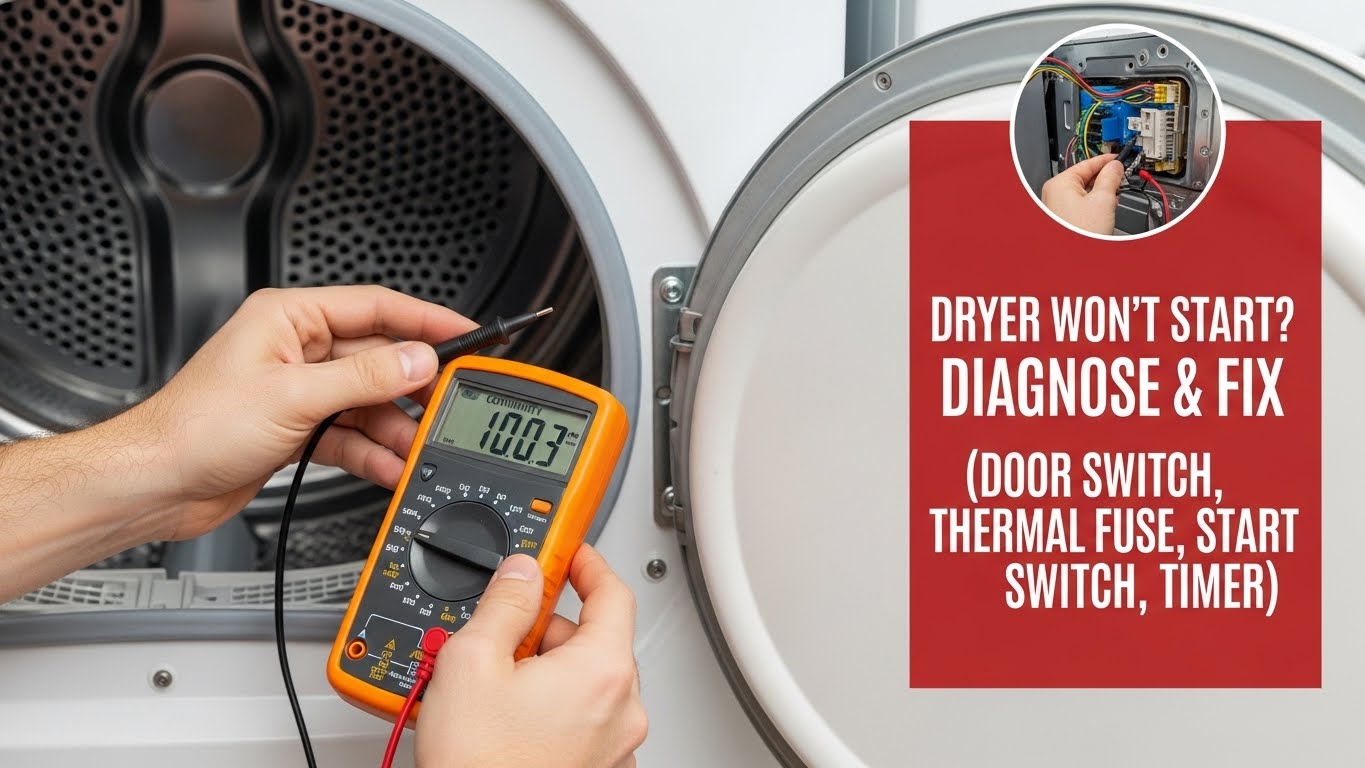
Dryer won’t start but has power (lights on)? Most cases are a blocked “start permission chain”: power is incomplete, a safety switch is open, or a thermal fuse opened after overheating.
Do these checks in order (fast + safe). This sequence is built to win time, avoid guessing, and reduce risk:
- Reset the breaker fully (OFF → ON). A dryer can “light up” on partial power.
- Door click + latch alignment test (close firmly; try lifting the door slightly while pressing Start).
- Timed Dry baseline (no Delay Start, no Eco/Sensor, no Child Lock).
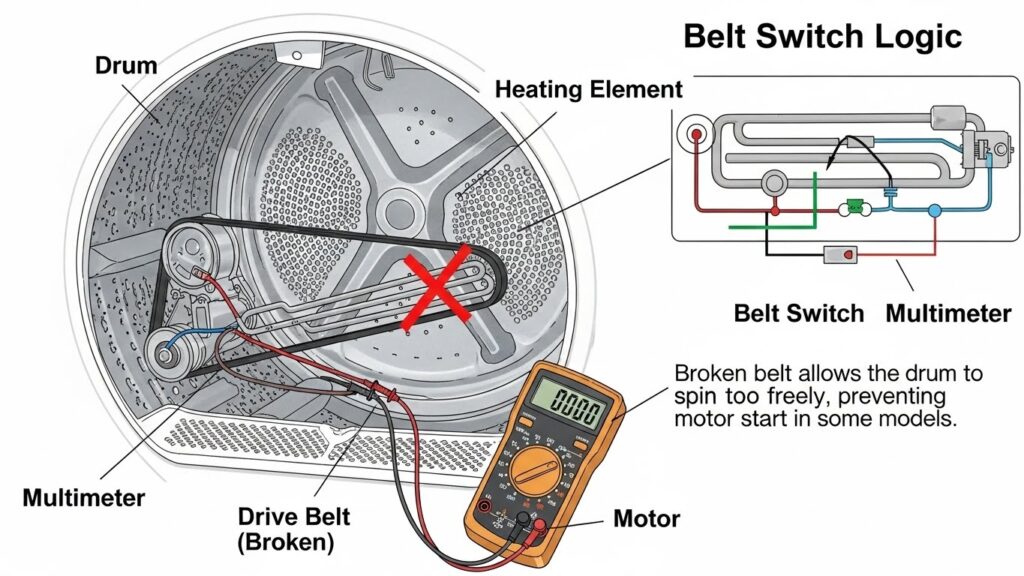
- Drum resistance check (if it spins “too freely,” suspect a broken belt / belt switch).
- Airflow check (weak venting can cause a thermal fuse to open).
- If trained: continuity test (thermal fuse / door switch / start switch) with power unplugged.
- Stop now if you smell burning or the cord/outlet feels hot.
Key number #1Electric dryers often use 240V (serious shock risk).
Key number #2A “good” closed switch often reads about 0–1Ω (near-zero resistance).
Key number #3A blown thermal fuse often reads OL / ∞ (open circuit).
Why this guide exists (one page, no guessing)
- Separates “panel has power” from “motor is allowed to start”.
- Prevents the common loop: replace a fuse → ignore airflow → fuse blows again.
- Keeps risky steps optional and clearly marked (DIY boundary included).
⚠️ Safety first (read before testing anything)
- Unplug first before moving the dryer, removing panels, or touching any wiring.
- Never bypass door switches, thermal fuses, or safety cutoffs “just to test.”
- Stop immediately if you smell burning, see smoke, or the outlet/cord feels hot.
- Gas dryer: any gas odor is a stop-now issue—ventilate and follow local safety guidance.
Dryer won’t start but has power — 7 checks for breaker, door switch, thermal fuse, belt, and start signal
Updated: 2026-01-23 • One-page workflow: prove power → prove interlocks → check belt/drum → verify airflow → confirm fuse/switch (if trained)
This is the confusing part: the display can light up and beep while the motor refuses to move. That’s not a “mystery glitch” as much as a safety design. The dryer only starts when a chain of conditions is met. Your job is to find which link is missing—without doing risky tests.
How a dryer decides to start (plain English)
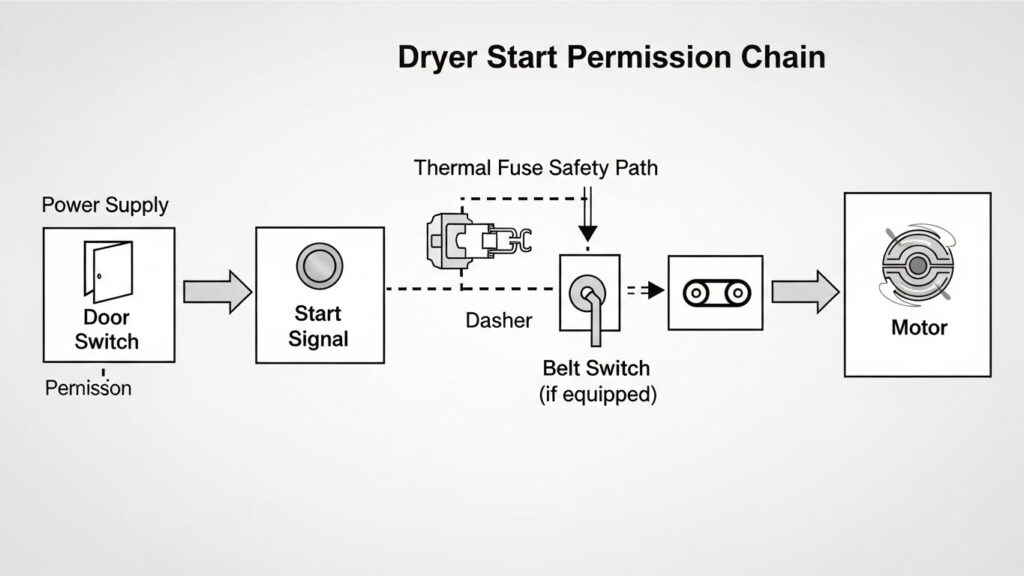
Think of “Start” as permission, not magic. The motor runs only if: (1) the dryer has the right power, (2) the door/lid safety is closed, and (3) heat-safety parts (like a thermal fuse) are intact. If any one of those is “no,” the dryer may still look alive—but it won’t run.
The logic in one line
Motor runs = Correct power AND Door switch closed AND Start signal AND Safety path intact
| What can block starting | What it does | What it feels like |
|---|---|---|
| Partial power (the “240V trap”) | Panel may get power while motor can’t | Lights on, beeps, but no motor movement |
| Door switch / latch | Proves the door is fully closed | Start does nothing unless you “hold/lift” the door |
| Broken belt / belt switch | Stops motor start if belt snaps (some models) | Drum spins too freely by hand; dryer won’t start |
| Thermal fuse / cutoff | Opens after overheating (often vent-related) | Suddenly won’t start after weeks of longer/hotter dry times |
The 7-check protocol (fastest truth first)
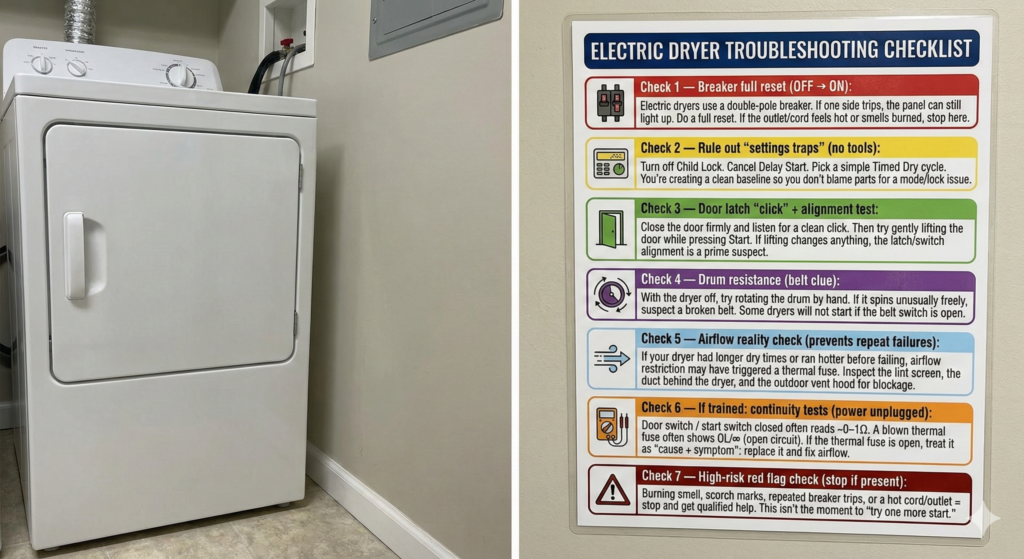
- Check 1 — Breaker full reset (OFF → ON):
Electric dryers use a double-pole breaker. If one side trips, the panel can still light up.
Do a full reset. If the outlet/cord feels hot or smells burned, stop here. - Check 2 — Rule out “settings traps” (no tools):
Turn off Child Lock. Cancel Delay Start. Pick a simple Timed Dry cycle.
You’re creating a clean baseline so you don’t blame parts for a mode/lock issue. - Check 3 — Door latch “click” + alignment test:
Close the door firmly and listen for a clean click. Then try gently lifting the door while pressing Start.
If lifting changes anything, the latch/switch alignment is a prime suspect. - Check 4 — Drum resistance (belt clue):
With the dryer off, try rotating the drum by hand. If it spins unusually freely, suspect a broken belt.
Some dryers will not start if the belt switch is open. - Check 5 — Airflow reality check (prevents repeat failures):
If your dryer had longer dry times or ran hotter before failing, airflow restriction may have triggered a thermal fuse.
Inspect the lint screen, the duct behind the dryer, and the outdoor vent hood for blockage. - Check 6 — If trained: continuity tests (power unplugged):
Door switch / start switch closed often reads ~0–1Ω. A blown thermal fuse often shows OL/∞ (open circuit).
If the thermal fuse is open, treat it as “cause + symptom”: replace it and fix airflow. - Check 7 — High-risk red flag check (stop if present):
Burning smell, scorch marks, repeated breaker trips, or a hot cord/outlet = stop and get qualified help.
This isn’t the moment to “try one more start.”
Quick sanity check
If the dryer ran slow / hot / with long dry times for a while, prioritize vent airflow. That pattern often comes right before a thermal cutoff opens.
Diagnostic matrix (what you see → best next move)
| Observation | Most likely bucket | Best first action | DIY boundary |
|---|---|---|---|
| Lights on, Start does nothing | Door switch / settings / partial power | Breaker reset + lock/delay off + door alignment test | Stop if outlet/cord is hot |
| Drum spins “too freely” by hand | Broken belt / belt switch (model-dependent) | Inspect belt system (service if unsure) | Service if disassembly is required |
| Long dry times before failure | Airflow restriction → overheating → fuse/cutoff | Prove airflow at outdoor hood; fix duct path | Vent service if inaccessible |
| Burning smell / hot outlet / scorch marks | Electrical hazard | Unplug; do not run; get qualified help | DIY ends here |
Timing plan (what to do in the next 30–90 minutes)
| Time window | Do this | Outcome |
|---|---|---|
| 0–10 minutes | Breaker reset + settings baseline + door latch test | Rules out the common “no-tools” blockers |
| 10–25 minutes | Drum resistance check + airflow check at outdoor hood | Finds belt clue or vent restriction |
| 25–60 minutes | Fix kinks/length issues; clean visible lint safely | Restores safer venting |
| 60–90 minutes | If trained: continuity checks (unplugged) or schedule service | Confirms whether a part is truly open |
Common mistakes (and why they backfire)
- “The panel has power, so power is fine.” Partial power can still light the panel while the motor can’t run.
- Replacing a thermal fuse without fixing airflow. The fuse may open again if venting stays restricted.
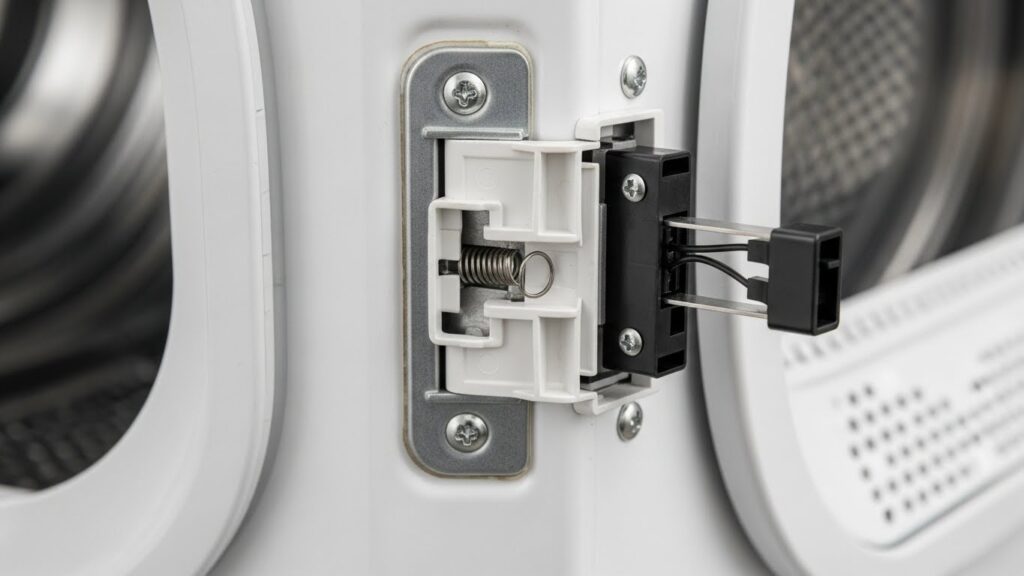
- Ignoring door sag / latch wear. A tiny misalignment can block the start permission chain.
- Jumping straight to “control board failure.” It can happen, but it’s rarely the first best bet.
Stop and call service (high-risk cases)
Stop if you notice burning/electrical odor, smoke, repeated breaker trips, a hot outlet/cord, or melted/charred wiring. For gas dryers, any gas odor is an immediate safety situation—ventilate and contact qualified help.
Repair vs replace (quick economics, not a sales pitch)
| Scenario | Typical DIY parts range | Practical verdict |
|---|---|---|
| Door switch / thermal fuse | Often low-cost | Usually worth fixing (but fix airflow if fuse opened) |
| Belt / idler / roller kit | Often moderate | Worth fixing if the dryer is otherwise healthy |
| Main control board | Can be expensive | Pause and compare vs dryer age and overall condition |
| Drive motor | Can be expensive | Often a replace decision on older units |
FAQ
Why does my dryer have power but won’t start?
Because the display can be powered while the motor is blocked by partial power, a door interlock, a belt switch (some models), or a thermal fuse/cutoff. This guide finds the missing link in the start permission chain.
What’s the single fastest “no-tools” check?
Fully reset the breaker (OFF → ON), then run a clean baseline: Timed Dry, no Delay Start, Child Lock off. If the cord/outlet feels hot or smells burned, stop.
Can a blocked vent cause a no-start condition?
Yes. Over time, restricted airflow can overheat the dryer and trigger a thermal fuse/cutoff. Fix venting before replacing heat-safety parts to avoid repeat failures.
My door closes, but it still won’t start. Any trick?
Try the latch alignment test: close the door, then gently lift it while pressing Start. If that changes anything, the door latch/switch alignment is a prime suspect.
What should a “good” switch or fuse read on a multimeter?
A closed switch often reads near 0–1Ω. A blown thermal fuse often reads OL / ∞ (open circuit). Always unplug before testing.
When do I stop DIY and call a technician?
If there’s burning odor, hot outlet/cord, repeated breaker trips, smoke, or you can’t safely access venting. Also stop if airflow is strong and the no-tools checks don’t change anything—internal diagnosis is safer with qualified service.
Internal Links
- https://homefixatlas.com/dryer-not-heating-2/ — If it starts but heat is missing or inconsistent, follow this diagnostic path
- https://homefixatlas.com/dryer-making-loud-noises/ — For squealing, scraping, or drum drag that can strain the motor system
- https://homefixatlas.com/laundry-comes-out-damp — If drying performance degraded before the no-start issue, begin here
Sources & References
Safety notice
This article is informational and prioritizes safe, non-invasive checks first. Electrical testing and internal repairs can be hazardous. If you suspect electrical overheating, smell burning, feel a hot outlet/cord, see smoke, or have any gas odor concerns, stop use and contact a qualified professional.
Update log: 2026-01-23 — Merged the strongest “permission chain” structure with critical edge cases (partial power/240V trap, belt switch clue, airflow→thermal fuse loop) while tightening safety boundaries and removing unverifiable claims.

I publish step-by-step troubleshooting guides for common home appliance issues (washer, dryer, refrigerator, HVAC basics).
Content is written for everyday homeowners and cross-checked with manufacturer manuals, safety guidance, and trusted public resources.
Posts include practical checks, clear stop-signs for safety, and guidance on when it’s better to call a qualified technician. Updates are logged whenever steps or recommendations change.
Safety note: If you smell gas, see burning, or suspect electrical hazards—stop immediately and contact a qualified professional.