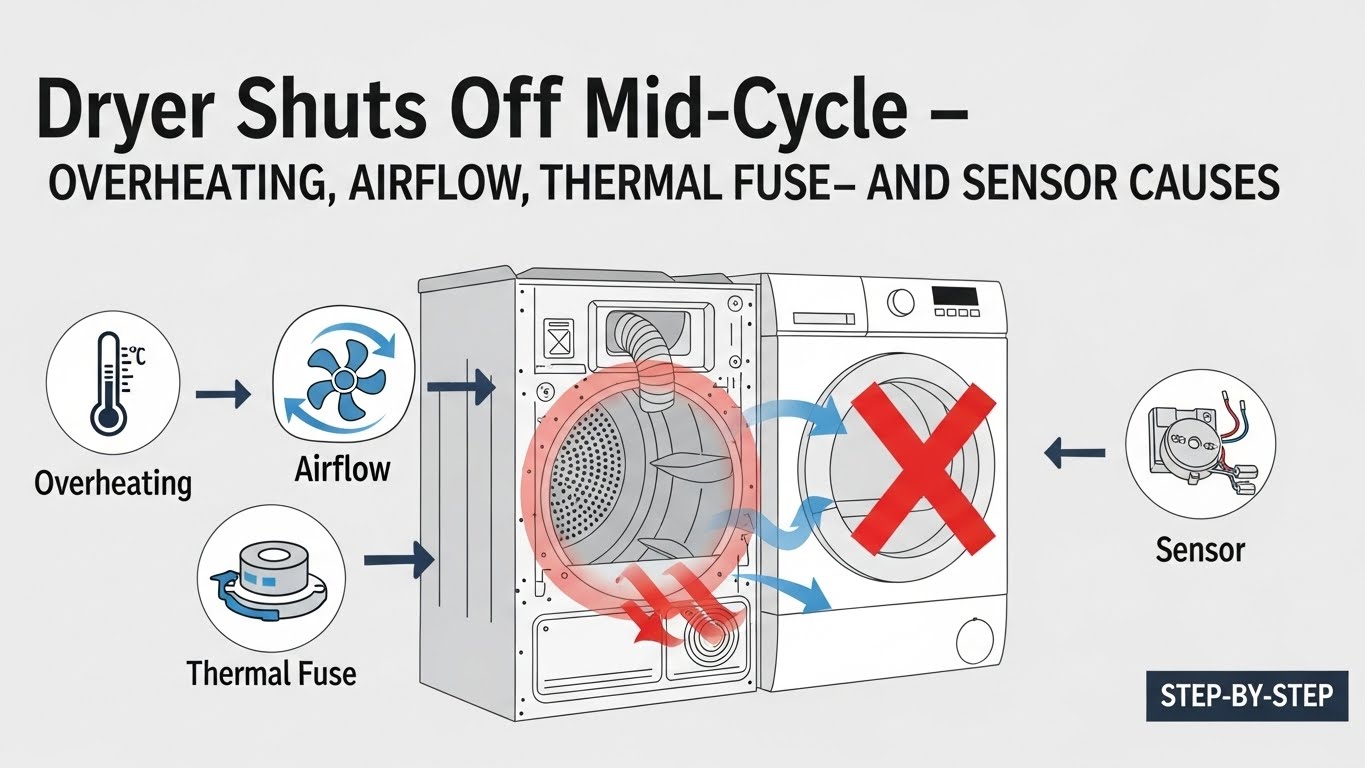
Dryer shuts off mid-cycle? Treat it like an overheating/airflow safety event first—then isolate sensors, friction, or a failing safety part.
A “random shutoff” usually isn’t random. Your dryer is often responding to a trigger: (1) trapped heat (vent restriction), (2) motor overload (drum drag/friction), or (3) sensor logic (moisture sensor confusion). This one-page workflow helps you prove the cause in the safest order—before you start replacing parts.
Key clue #1Restarts after 10–20 minutes? Think heat trip (overheat protection) before electronics.
Key clue #2Weak outdoor vent airflow is a “stop-and-fix” issue. Don’t keep restarting.
Key clue #3If it stops mostly on Sensor/Auto cycles, run a Timed Dry test to isolate sensors vs airflow.
What you’ll do on this page
- Confirm it’s a true shutdown (not normal pausing/tumbling behavior).
- Prove airflow at the outdoor hood (fastest real-world truth test).
- Separate sensor logic from heat/fuse issues using Timed vs Sensor cycles.
- Know exactly where DIY ends (high voltage, gas odors, scorched wiring).
⚠️ Safety first: heat + lint + electricity / gas
- Unplug the dryer before moving it, touching duct connections, or opening any panels.
- Stop immediately if you smell burning/electrical odor, see smoke, or the plug/outlet feels hot.
- Gas dryer: any gas odor is a stop-now situation—ventilate and follow local gas safety guidance.
- If you see scorching, melting, or charring, do not keep testing. Qualified inspection is safer.
Updated: 2026-01-23 • One-page workflow: confirm shutdown → prove airflow → isolate heat/safety/sensor causes
Mid-cycle shutoffs feel like a glitch—until you notice the pattern: it runs, stops, cools, then runs again… or it stops only on sensor cycles. Dryers are built with protective “stop” behavior for a reason. The safest approach is to treat every unexpected stop as a potential overheating/airflow event first, because that’s the category with the highest fire risk and the fastest payoff to rule in/out.
On this page1) How shutoffs work (simple model)
2) 2-minute triage (stop vs test)
3) 5-step diagnostic protocol
4) Brand-specific patterns (Samsung/LG/Whirlpool)
5) Diagnostic matrix + timing plan
6) Repair vs replace decision
7) FAQ
How mid-cycle shutdowns work (plain English + one simple model)
Think of your dryer as a heater + fan + safety controls. The heater makes hot air, the fan moves it through clothes, and the vent sends it outside. When airflow drops (lint, crushed duct, blocked vent hood), heat stays inside longer. Safety parts may cut heat or stop the machine to prevent damage. On many models, the motor also has a thermal protector that trips if the motor is overheating from heat buildup or mechanical drag.
The “why” in one line (easy version)
Less airflow = more trapped heat: Overheat Risk ∝ (Heat Output) ÷ (Airflow)
| What you notice | What it usually points to | Best first test |
|---|---|---|
| Stops, then works again after cooling | Overheat protection (airflow restriction or motor overload) | Outdoor vent airflow test |
| Stops + clothes feel unusually hot | Heat trapped (vent/duct restriction) | Vent hood flap + duct inspection |
| Stops mostly on Sensor/Auto cycles | Moisture sensor logic vs airflow interaction | Timed Dry isolation test + sensor cleaning |
| Stops + burning/electrical smell or hot plug | Electrical hazard risk | Unplug and stop testing |
The 2-minute triage: should you test or stop?
Stop now (no more cycles) if any of these are true
- Burning/electrical odor, smoke, or visible scorching
- Outlet/plug/cord feels hot or looks discolored
- Breaker trips repeatedly or lights flicker when the dryer runs
- Gas odor (gas dryers)
If it seems safe to test
Use a short Timed Dry run only long enough to check airflow at the outdoor vent hood. You’re not trying to finish laundry—you’re trying to get one clean clue: strong airflow vs weak airflow.
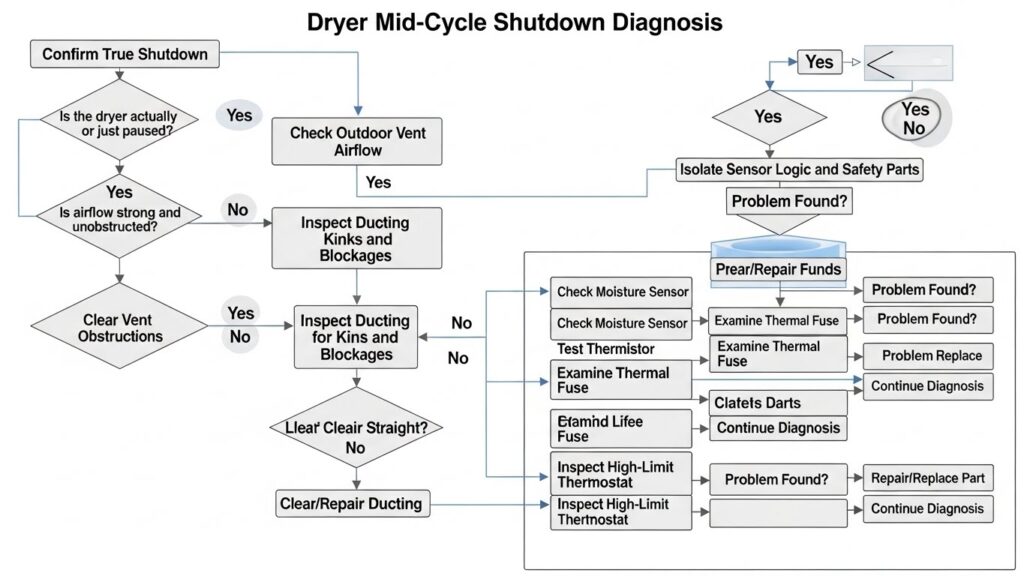
Priority diagnostic protocol (5 steps, safest order)
- Step 1 — Confirm it’s a true shutdown (not normal cycle behavior):
Some cycles pause or tumble intermittently, which can look like “stopping.” Listen for the motor and watch for drum movement.
If it truly shuts off, note two things: (a) do the controls stay lit? and (b) does it run again after cooling?
If there’s any burning/electrical odor or the plug is hot: unplug and stop here. - Step 2 — Run the Timed Dry isolation test (sensor vs non-sensor):
If shutoffs happen mostly on Sensor/Auto cycles, run Timed Dry for a short window.
Runs fine on Timed Dry but stops early on Sensor Dry? That’s a strong hint the sensor system is misreading moisture, often from residue on sensor bars or airflow/sensor interaction. - Step 3 — Prove airflow at the outdoor vent hood (fastest truth test):
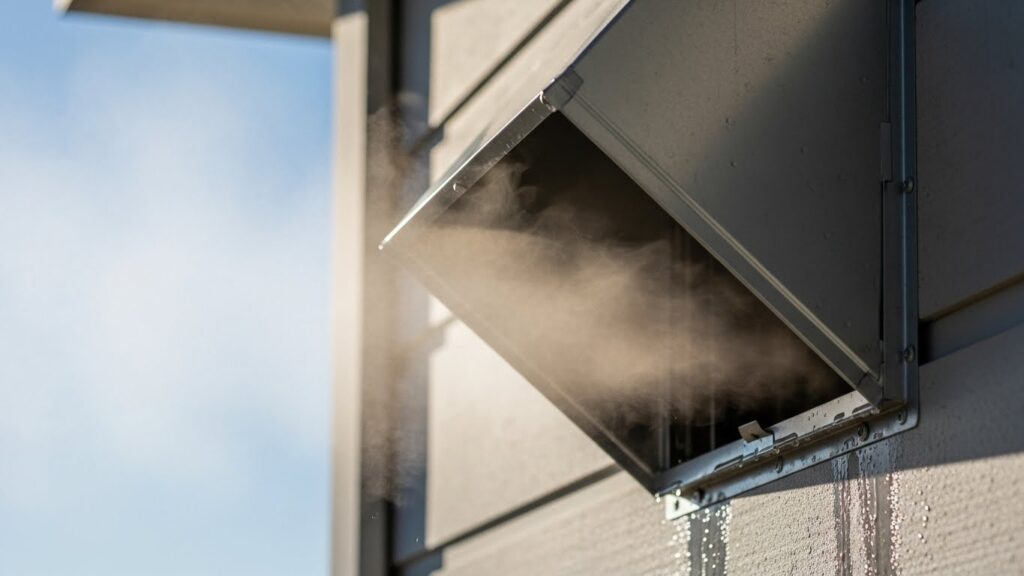
While the dryer runs briefly on Timed Dry (only if safe), go outside and check airflow at the hood.
You want steady warm air and a flap that opens freely. Weak airflow = restriction you must fix before you keep testing.
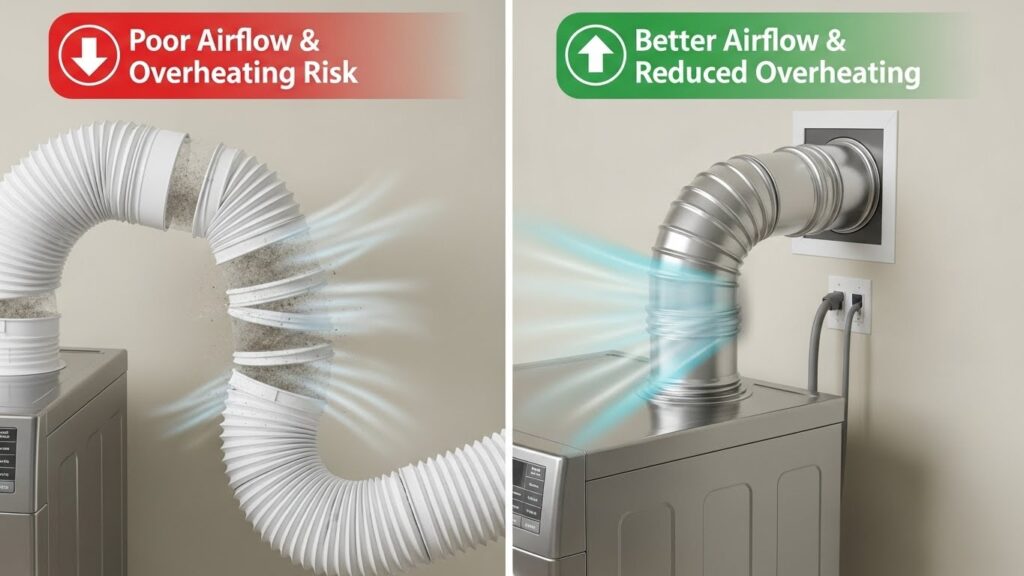
Clear visible lint mats and debris safely. - Step 4 — Fix the #1 hidden restriction: the transition duct behind the dryer:
Unplug the dryer, pull it out carefully, and inspect the duct right behind it.
Look for crushed bends, kinks, sagging flex duct, or an overly long run. Straighten, shorten, and secure connections.
After adjustments, re-check outdoor airflow as your confirmation step. - Step 5 — If airflow is strong, suspect motor overload (drum drag) or a failing safety/electrical part:
If airflow is proven good but shutoffs continue, check for drum drag clues (squeal/scrape, drum hard to turn by hand).
Persistent shutoffs with strong airflow can also involve thermal fuses/thermostats or power terminal issues.
Basic electrical testing can be dangerous—if you’re not trained, stop here and use qualified service.
Pro tip: the “cool-down restart” pattern
If it shuts off, cools for 10–20 minutes, then runs again briefly—treat it like a heat trip first. Don’t chase sensors or boards until you’ve proven airflow and reduced heat buildup.
Brand-specific shutoff patterns (quick clues, not guesses)
- Samsung: Some models show heater/thermistor-related codes (examples include HC / tS on certain lines). Even without a code, repeated shutoffs plus weak airflow often trace back to vent restriction or internal lint buildup.
- LG (FlowSense models): If FlowSense indicators rise or warnings appear, the dryer may be reporting vent restriction in the home’s ducting. Treat it as an airflow problem until proven otherwise.
- Whirlpool/Maytag: Many models use a thermal fuse or high-limit safety device that may open if overheating occurs. If the dryer won’t restart at all (even after cooling), a safety device may have opened—airflow must be corrected before any part replacement.
Reality check (EEAT-style): the cheapest fix is often the first fix
It’s common to blame the control board because it “feels electronic.” But airflow restrictions can mimic sensor or board problems. That’s why this guide forces airflow proof early—so you don’t pay for parts while the real cause stays in the vent path.
Diagnostic matrix (symptom → best next move)
| Symptom | Most likely bucket | Next action (safest first) | Stop now? |
|---|---|---|---|
| Stops, then restarts after cooling | Heat trip (airflow restriction or motor overload) | Prove outdoor airflow → fix transition duct → re-test | If burning smell / hot plug |
| Stops + long dry times | Airflow restriction | Vent hood + duct kinks/length + deep vent cleaning | Yes (until airflow is fixed) |
| Stops only on Sensor/Auto cycles | Sensor logic / residue + airflow interaction | Timed Dry test → clean sensor bars → confirm airflow | If heat is excessive |
| Stops + electrical odor / hot outlet / charring | Electrical hazard | Unplug; do not run; qualified inspection | DIY ends here |
Timing plan (so you don’t chase the wrong thing)
| Time window | Do this | What you’re proving |
|---|---|---|
| 0–2 minutes | Stop, unplug, cool-down, smell/hot plug check | Immediate safety |
| 5–10 minutes | Short Timed Dry (if safe) → outdoor airflow check | Airflow restriction yes/no |
| 20–40 minutes | Inspect/straighten/shorten transition duct | Choke point removed |
| 45–90 minutes | Deep vent cleaning or vent service | Long-run vent is safe |
Common mistakes that keep the problem alive
- Restarting repeatedly without proving airflow: heat trips will keep returning.
- Cleaning only the lint screen: restrictions often sit behind the dryer or at the outdoor hood.
- Using long sagging flex duct: sags trap lint and heat, and can create shutdown loops.
- Skipping the Timed Dry isolation test: you lose the fastest way to separate sensor logic from heat/airflow.
- Ignoring electrical smell or hot plug symptoms: those deserve a stop-now response, not trial-and-error.
Repair vs replace (practical decision guide)
Most mid-cycle shutoff cases are worth fixing—especially when the root cause is airflow restriction, sensor residue, or routine wear items. Replacement makes more sense when repair costs approach the value of the dryer, or when electrical damage is present.
| Scenario | Typical direction | Why it matters |
|---|---|---|
| Airflow restriction / vent cleaning | Fix | High safety payoff, often restores normal operation |
| Sensor residue / false early shutoff | Fix | Low-cost, high-impact; Timed vs Sensor test confirms |
| Drum drag (rollers/belt/idler) | Fix | Reduces motor overload and heat trips |
| Scorched wiring / hot terminal block / burning electrical smell | Service-first (replace may be reasonable) | Safety-critical; avoid repeated testing |
Serious warning: heat behaving “wrong”
If the dryer seems to keep heating abnormally, produces smoke, or gives persistent electrical odors, stop use immediately. These conditions can indicate a dangerous fault that should be evaluated by qualified service before the dryer is used again.
FAQ
Why does my dryer shut off, then work again later?
That “works after cooling” pattern often points to a heat trip—overheating protection triggered by trapped heat (airflow restriction) or motor overload (drum drag). Start with the outdoor vent airflow test and the transition duct behind the dryer.
Can a clogged vent really make the dryer stop mid-cycle?
Yes. Restricted exhaust can trap heat long enough to trigger safety behavior. The outdoor vent hood test is the fastest way to confirm whether airflow is the problem.
My dryer shuts off only on Sensor Dry. What does that mean?
It often means sensor logic is getting unreliable (sometimes due to residue on sensor bars) or airflow/sensor interaction is confusing the cycle. Run Timed Dry as a comparison, then clean sensor bars and confirm airflow.
What’s the quickest test that gives the most information?
Outdoor vent airflow. Strong airflow rules out the most common high-risk category (vent restriction). Weak airflow is a fix-first condition—don’t keep restarting.
Is it safe to keep running it if it shuts off mid-cycle?
Repeated shutdowns should be treated as a warning. If clothes feel unusually hot, airflow is weak, or you notice any burning odor, stop and fix airflow first. If electrical odor or a hot plug/outlet is present, stop immediately.
When do I stop DIY and call a professional?
Stop DIY if you have burning/electrical smells, smoke, repeated breaker trips, a hot outlet/cord, gas odors, or visible heat damage. Also stop if airflow is proven strong but shutdowns continue—internal electrical diagnostics are safer with qualified service.
Internal Links
- https://homefixatlas.com/laundry-comes-out-damp — Helps separate airflow vs sensor vs load size when clothes stay damp
- https://homefixatlas.com/dryer-making-loud-noises/ — Use this if shutdowns come with squealing, scraping, or drum drag
- https://homefixatlas.com/dryer-not-heating-2/ — If airflow is strong but heat is inconsistent, start here
Sources & References
Professional safety notice
This guide is informational and focuses on safe airflow-first troubleshooting. Dryers involve high heat and (for many models) high voltage. If you suspect electrical overheating, see smoke, notice a hot outlet/cord, or have any gas odor concerns, stop use and contact a qualified professional.
Update log: 2026-01-23 — Combined airflow-first shutdown workflow with sensor-vs-timed isolation, brand-specific patterns, and clearer DIY safety boundaries.

I publish step-by-step troubleshooting guides for common home appliance issues (washer, dryer, refrigerator, HVAC basics).
Content is written for everyday homeowners and cross-checked with manufacturer manuals, safety guidance, and trusted public resources.
Posts include practical checks, clear stop-signs for safety, and guidance on when it’s better to call a qualified technician. Updates are logged whenever steps or recommendations change.
Safety note: If you smell gas, see burning, or suspect electrical hazards—stop immediately and contact a qualified professional.