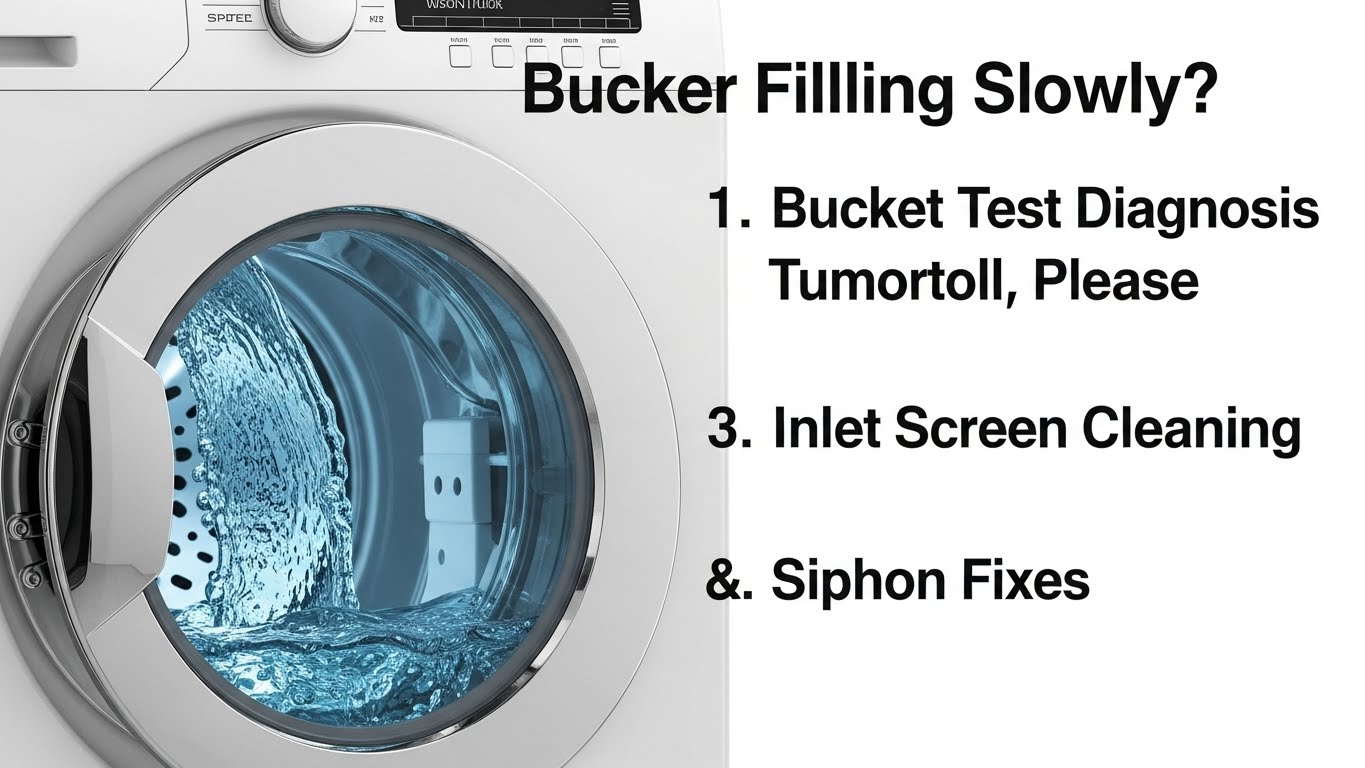
Washer taking forever to fill? Do the “Bucket Test + Siphon Check” before you buy any parts.
Slow fill is usually not a “bad computer.” It’s almost always one of three buckets: (1) low supply pressure, (2) restricted flow (kinked hose or clogged inlet screens), or (3) siphoning (water leaving as fast as it enters because of drain-hose setup). This page is built so you can isolate which bucket you’re in in under 15 minutes — safely.
The 3-Minute Diagnostic Triangle (no guesswork)
- Bucket Test (house vs washer): Strong flow into a bucket means the house supply is fine — suspect washer-side restriction/valve.
- Screen Check (most common): Tiny inlet screens at the washer ports trap sediment and can cut flow dramatically.
- Siphon Loop (fills forever): If the washer “keeps filling” but level won’t rise, the drain hose may be set to siphon.
⚠️ Safety: Pressurized water + electricity
- Turn off BOTH valves first before disconnecting hoses (unexpected spray can injure you).
- Unplug the washer before moving it or cleaning screens (water + power is dangerous).
- Stop if you smell burning, see sparks/arcing, feel a hot plug/outlet, or breakers/GFCI trip repeatedly.
- Old hose warning: If rubber hoses are older, moving them can crack them. Have braided replacements ready.
Updated: 2026-01-18 • One-page deep guide • References at the end
A “slow fill” can turn a normal cycle into an all-day situation. The tricky part is that the symptom looks the same whether the culprit is house-side pressure, a tiny clog at the washer inlet, or a drain-hose setup mistake that quietly siphons water out while filling.
The goal here is simple: stop guessing. We’ll split the problem into pressure vs restriction vs siphon, then follow a safe sequence that keeps you from buying parts you don’t need — and keeps a “slow fill” from turning into a leak or electrical hazard.
Where the bottleneck hides (the “fill chain” model)
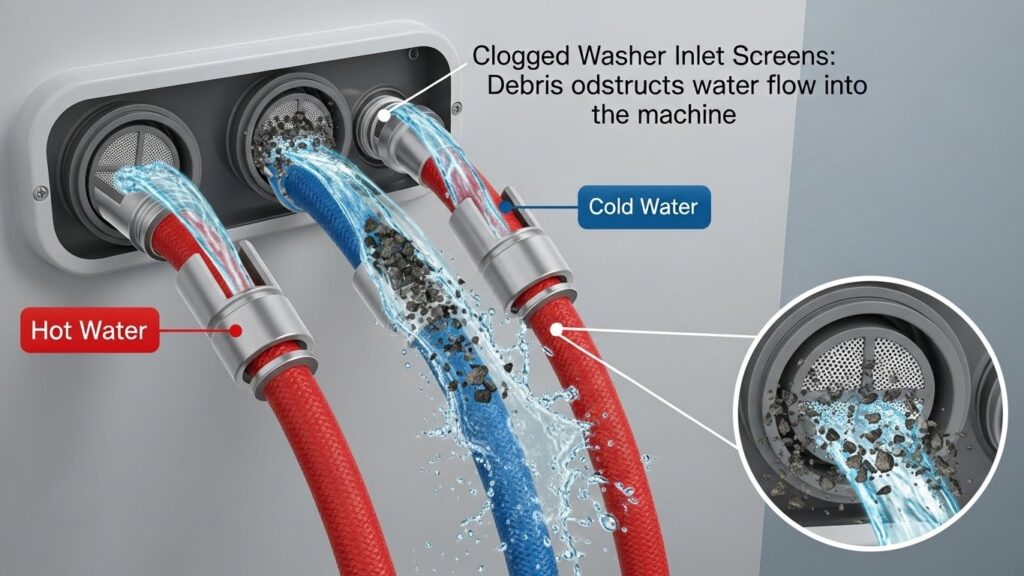
Filling is a chain. Water must pass through wall valves → hoses → inlet screens → inlet valve (solenoids). If any link is restricted, the washer may fill slowly or throw “long fill” errors. If the drain setup creates siphon, the washer can appear to fill forever.
| Bucket | Root cause | What you’ll notice |
|---|---|---|
| Supply / pressure | Partially closed valve, low house pressure, shared fixtures running | Hot AND cold fill slow; nearby faucets also feel weak |
| Restriction | Kinked hose, clogged inlet screens, debris at inlet port | Hot slow / cold normal (or vice versa); faucet pressure seems fine |
| Siphon / drain setup | Drain hose too low, air-tight seal, pushed too deep | Washer “fills forever” but water level never seems to rise |
15-minute fix protocol (in the right order)
- Step 1 — Temperature split (2 minutes):
Try a quick Hot fill, then Cold fill. If only one side is slow, you’re almost certainly dealing with a restriction on that side (hose kink, clogged screen, partially closed valve). - Step 2 — Wall valve + hose routing audit (3 minutes):
Confirm both wall valves are fully open. Then look behind the washer: a hose can get crushed when the washer is pushed back. Use your phone camera as a “periscope” if space is tight. - Step 3 — The Bucket Test (house vs washer) (5 minutes):
Turn off both valves. Disconnect hoses from the washer side. Aim each hose into a bucket and briefly open the valve. Strong stream = house pressure is fine. Weak stream = house-side supply issue (plumber territory). - Step 4 — Clean the inlet screens safely (8–15 minutes):
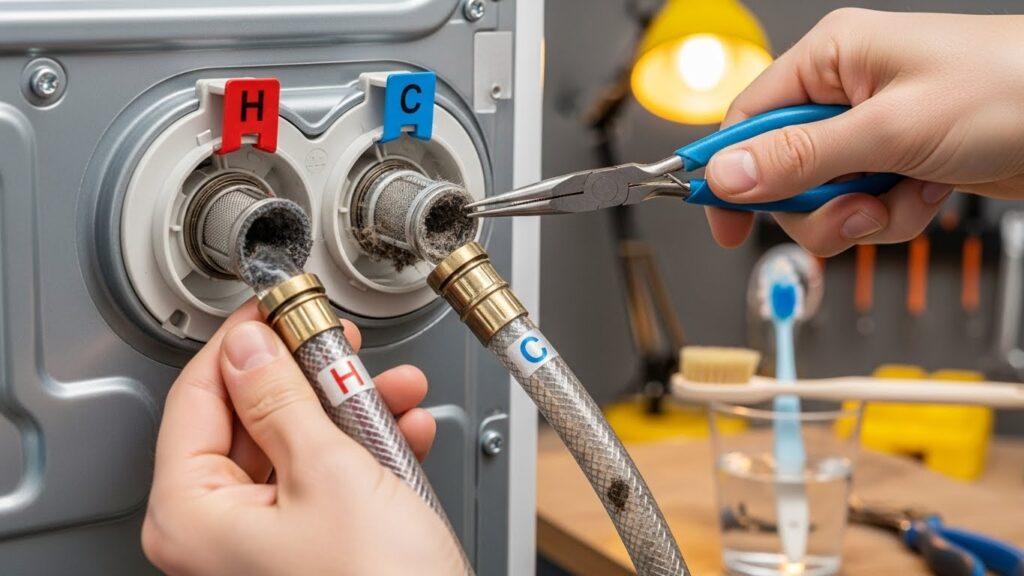
With water off and hoses removed, inspect the tiny mesh screens inside the washer inlet ports. Clean gently with a soft toothbrush. Do not puncture or remove the screens. - Step 5 — Siphon check (5 minutes):
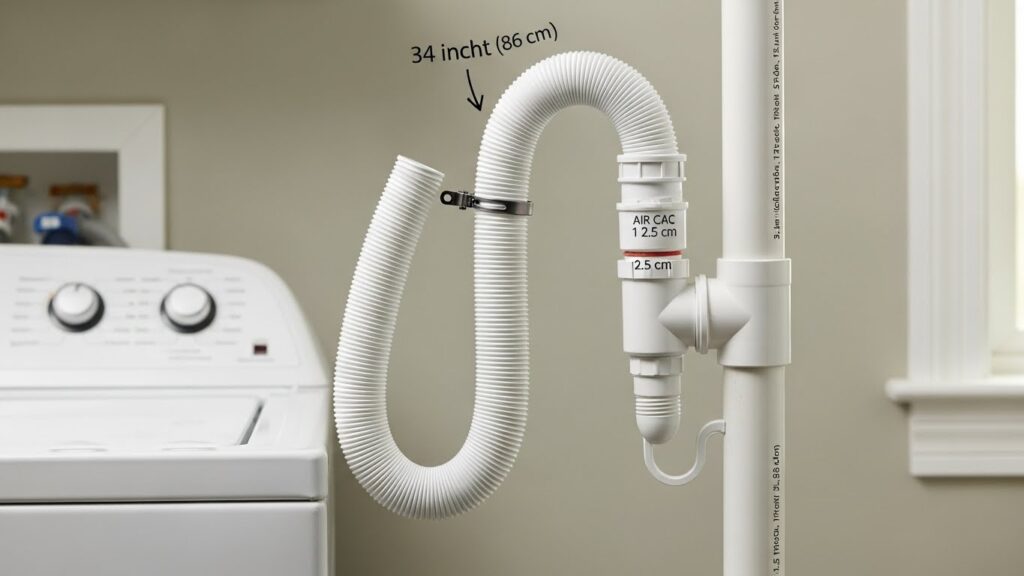
If the washer seems to fill forever but the level won’t rise, inspect the drain hose setup. Avoid an air-tight seal; don’t push the hose too deep into the standpipe. Keep a proper air gap so siphon can’t form.
Pro tip: the “one-side clue” is huge
If only hot or only cold is slow, stop thinking “computer.” One-side slow fill almost always comes from a restriction on that side (valve not fully open, kinked hose, clogged inlet screen).
Special case: “FloodSafe” / auto-shutoff hoses
Some hoses contain an internal safety valve that shuts if it senses a surge. In real homes, that surge can happen during normal washer filling, and the hose may “half-trip” — leaving you with a weak trickle that looks like a washer failure.
How it presents
- Flow suddenly becomes a trickle with no other changes.
- Bucket test may look weaker than expected even if house pressure is generally okay.
- Problem appears after moving the washer or after a water shutoff event.
Diagnostic matrix (symptom → clean next step)
| Symptom | Most likely cause | Best first action | Avoid |
|---|---|---|---|
| Hot AND cold slow | Supply / pressure / valve not fully open | Check wall valves + Bucket Test | Replacing inlet valve first |
| Hot slow, cold normal (or vice versa) | Restriction (one side) | Inspect hose routing + clean that port’s inlet screen | Ignoring hose pinch behind washer |
| Fills forever, level won’t rise | Siphoning through drain hose setup | Fix drain hose height/air gap | Running cycles repeatedly |
| Supply strong, screens clean, but no water enters | Washer inlet valve/solenoid or control issue | Electrical diagnostics (multimeter) or service | Assuming it must be a clog |
Troubleshooting timeline (efficiency-first)
| Action | Time | Verdict you get |
|---|---|---|
| Temperature split + valve check | 2–4 min | One-side vs both-side clue + rules out half-closed valve. |
| Bucket Test | 4–6 min | House supply vs washer-side restriction becomes obvious. |
| Clean inlet screens | 8–15 min | Fixes the #1 restriction cause without parts. |
| Siphon / drain hose check | 5–10 min | Explains “fills forever” cases that mimic slow fill. |
Common DIY mistakes (these waste hours)
- Replacing the inlet valve too soon: without the Bucket Test, you’re guessing.
- Puncturing or removing inlet screens: debris can jam the valve open and cause flooding.
- Missing hose pinch behind the washer: a crushed hose can mimic a failing valve.
- Forgetting siphon physics: a bad drain hose setup can make you believe the washer “won’t fill.”
- Overlooking auto-shutoff hoses: FloodSafe-style hoses can restrict HE washer flow unexpectedly.
Stop line: call a pro
Unplug and stop if you see water near outlets, smell burning, see sparks/arcing, feel a hot plug/outlet, or breakers/GFCI trip repeatedly. If you need to test live voltage or solenoid coils, it’s safer to use a qualified technician.
FAQ
Why does my washer take forever to fill?
Most slow fills fall into three buckets: low supply pressure, restricted flow (kinked hose or clogged inlet screens), or siphoning from the drain hose setup. Start by checking whether both hot and cold are slow or just one side.
Cold fill is slow but hot is fine — what does that mean?
That pattern usually means a restriction on the cold side: a partially closed valve, a kinked hose, or a clogged inlet screen at the cold port.
Do I need a plumber or an appliance technician?
Use the Bucket Test. Weak flow from the wall hose points to house-side supply (plumber). Strong flow from the wall hose but slow washer fill points to washer-side restriction or valve issues.
Can I remove the inlet screens to improve flow?
No. Screens protect the inlet valve. If grit gets in, the valve can stick open and cause flooding. Clean screens gently instead.
What is siphoning, and how does it mimic a fill problem?
Siphoning is when the drain hose pulls water out while the washer is filling. The washer may “keep trying” to reach a level that never stabilizes. Fixing drain hose height and leaving an air gap prevents this.
How do I know the inlet valve solenoid is actually bad?
If house flow is strong, screens are clean, hoses aren’t kinked, and there’s still no water entering (with normal washer behavior), then the inlet valve/solenoid or control path may be at fault. Electrical testing should be done with proper tools and safety training.
Expert troubleshooting resources
- Washer Not Draining Guide — Drain-path checks that prevent standing water and long cycles
- Washer Leaves Detergent Residue — Why low flow/rinse issues leave soap on clothes
- Washer Smells Bad — Deep cleaning routine (prevents odor and buildup-related flow issues)
Technical references
Safety notice
This guide is informational and focuses on safe, non-invasive checks. If you notice leaks near electrical areas, burning smell, sparks/arcing, a hot outlet/plug, repeated breaker/GFCI trips, or any shock/tingle sensation, unplug the washer and consult a qualified technician.

I publish step-by-step troubleshooting guides for common home appliance issues (washer, dryer, refrigerator, HVAC basics).
Content is written for everyday homeowners and cross-checked with manufacturer manuals, safety guidance, and trusted public resources.
Posts include practical checks, clear stop-signs for safety, and guidance on when it’s better to call a qualified technician. Updates are logged whenever steps or recommendations change.
Safety note: If you smell gas, see burning, or suspect electrical hazards—stop immediately and contact a qualified professional.