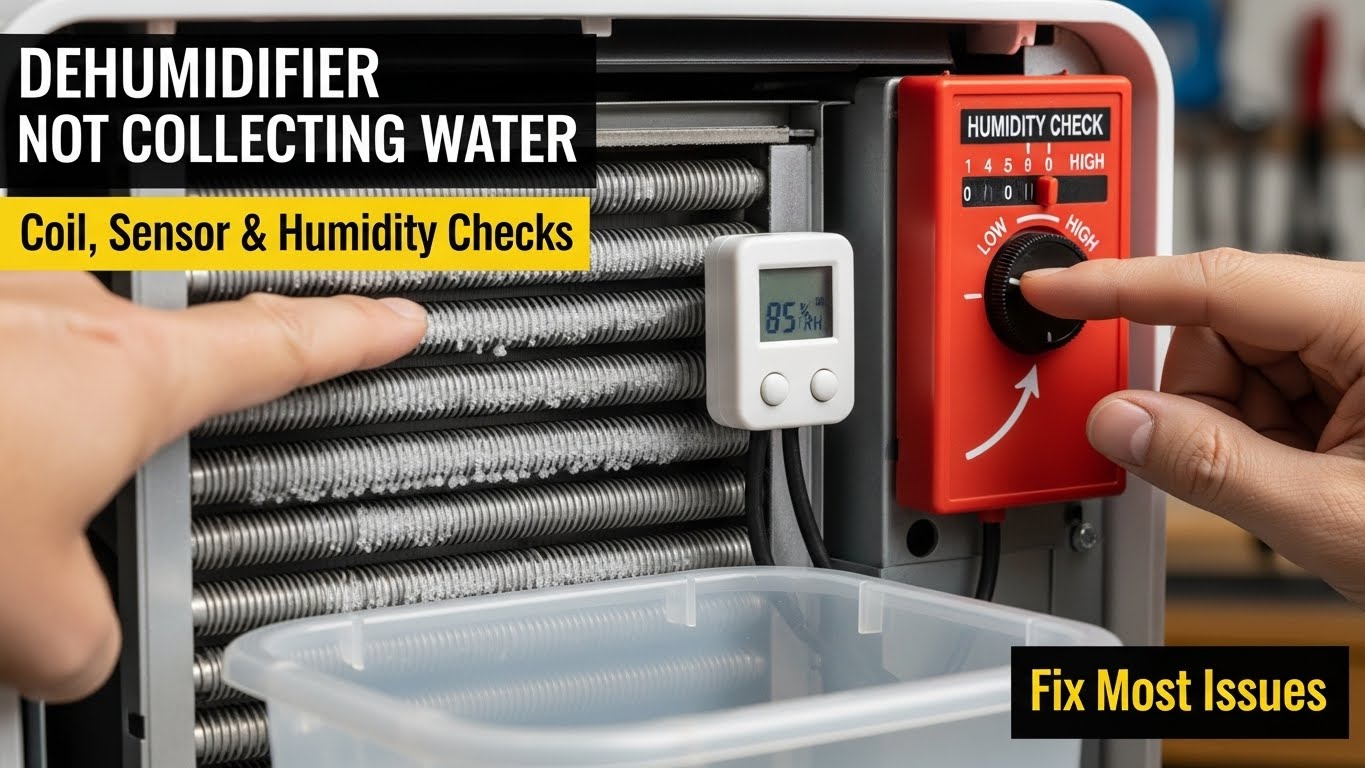
Why is my dehumidifier not collecting water?
In most cases, a dehumidifier that runs but collects no water is not “broken.” It’s reacting to normal room conditions. Water only forms when the evaporator coil becomes colder than the air’s dew point. If that condition isn’t met, the unit may run, move air, and still produce no water.
The checklist below helps you separate a normal condition from a real fault without guessing.
Safety First: Always unplug the dehumidifier before cleaning the filter, brushing coils, or inspecting the bucket switch. Never use sharp tools on coil fins. If you suspect a sealed-system or refrigerant issue, stop DIY and contact a qualified technician.
Last Updated: January 10, 2026 | Technical Review: HomeFix Atlas (Appliance Troubleshooting) | Note: Informational only (not professional repair advice)
Quick Standard: 7-minute “No-Water” Reality Check
- Feel the air: after 10–15 minutes, the exhaust air should feel a bit warmer than the room.
- Check humidity: if indoor humidity is already around the mid-40s% or lower, water output can be minimal.
- Check temperature: cool basements/garages often reduce or stop condensation.
- Fix airflow first: clean the filter and make sure intake/exhaust aren’t blocked.
- Bucket switch test: confirm the “full” sensor isn’t stuck (even if the bucket is empty).
A lot of people expect a dehumidifier to “always” collect water. But dehumidifiers don’t create water out of nowhere—they condense moisture that already exists in the air. If your room air is too dry, too cool, or the unit can’t move air across the coils efficiently, the bucket can stay empty.
The good news is that most no-water cases come from conditions, not expensive failures. The key is checking the easy, high-probability causes first, then moving to deeper diagnosis only if the basics look normal.
Table of Contents
- 1) What “no water” really means (dew point in plain English)
- 2) The fast checks that solve most cases
- 3) Airflow problems: the hidden #1 cause
- 4) Bucket, float switch, and drainage issues
- 5) When it might be a real mechanical fault
- FAQ
- Related Guides
- References
- Important Safety & YMYL Notice
1) What “no water” really means (dew point in plain English)
A dehumidifier removes moisture by pulling humid air across a cold evaporator coil. Water forms only when the coil temperature drops below the air’s dew point. If the dew point is low (because humidity is low or the room is cool), condensation may be extremely slow or not happen at all.
Easy way to think about it: If the air doesn’t have “enough moisture” or isn’t warm enough to support condensation, the bucket stays empty. That can be normal—especially in winter, in cool basements, or after the unit already did its job.
2) The fast checks that solve most cases
Check actual room humidity (don’t guess)
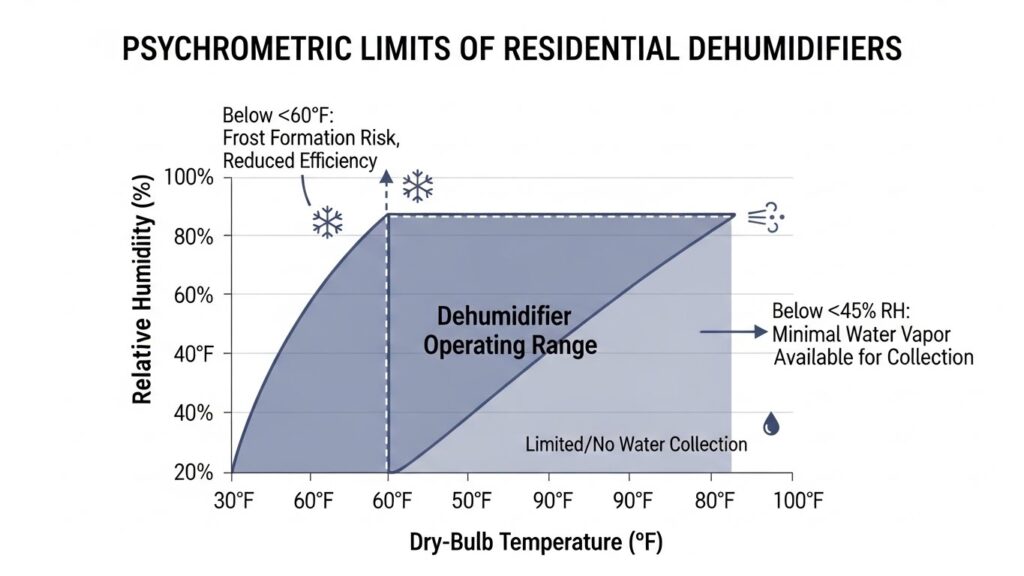
If the room is already relatively dry, water output can be tiny. A small hygrometer is the simplest reality check. If humidity is hovering around the low-to-mid 40% range or lower, “no water” can happen even when the unit is functioning.
Check room temperature (cool spaces change everything)
Many standard residential dehumidifiers struggle in cooler environments because condensation slows down and the coil may ice up instead of dripping water. Basements and garages are common trouble spots, especially in colder seasons.
Confirm the humidity setting and mode
If the set humidity is already reached, the unit may run intermittently or mainly circulate air. Try “Continuous” mode for a short test window (while monitoring for icing) to see whether any water begins to collect.
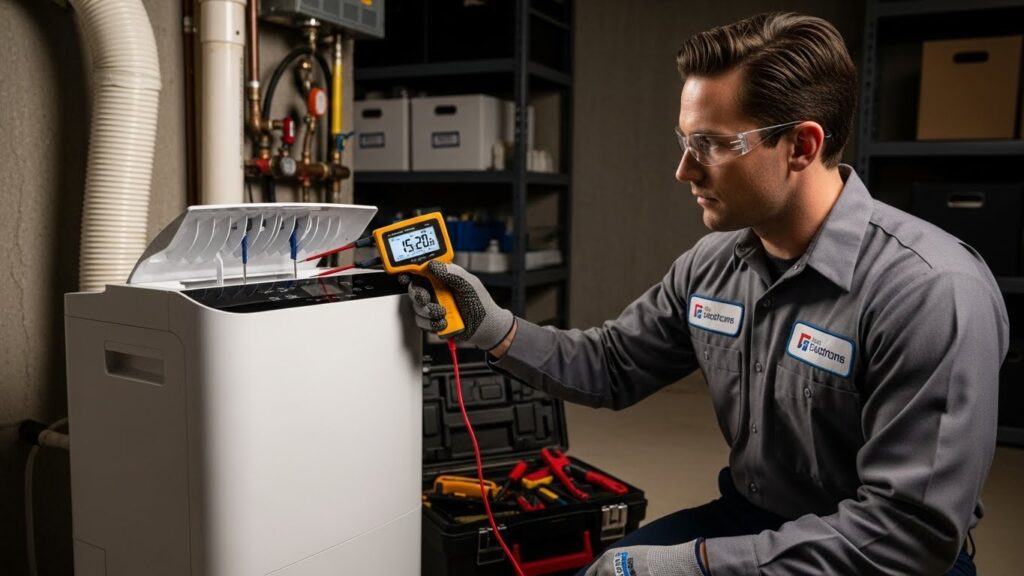
3) Airflow problems: the hidden #1 cause
Even when humidity is high enough, a dehumidifier can collect no water if air can’t pass through the unit properly. Reduced airflow means less moist air reaches the cold coil, so condensation drops.
Clean the air filter (the easiest win)
A clogged filter restricts airflow and often makes the unit feel like it’s “running” but not dehumidifying. Clean or replace the filter per the manual, then re-test for 30–60 minutes.
Clean the evaporator coil gently
Dust buildup acts like insulation. When air can’t contact cold metal effectively, condensation stalls. Use a soft brush or a coil-safe cleaner. Avoid bending fins—damaged fins reduce airflow permanently.
Quick airflow clue: If the air coming out feels weak compared to before, treat it as an airflow problem first. Airflow issues are far more common than sealed-system failures.
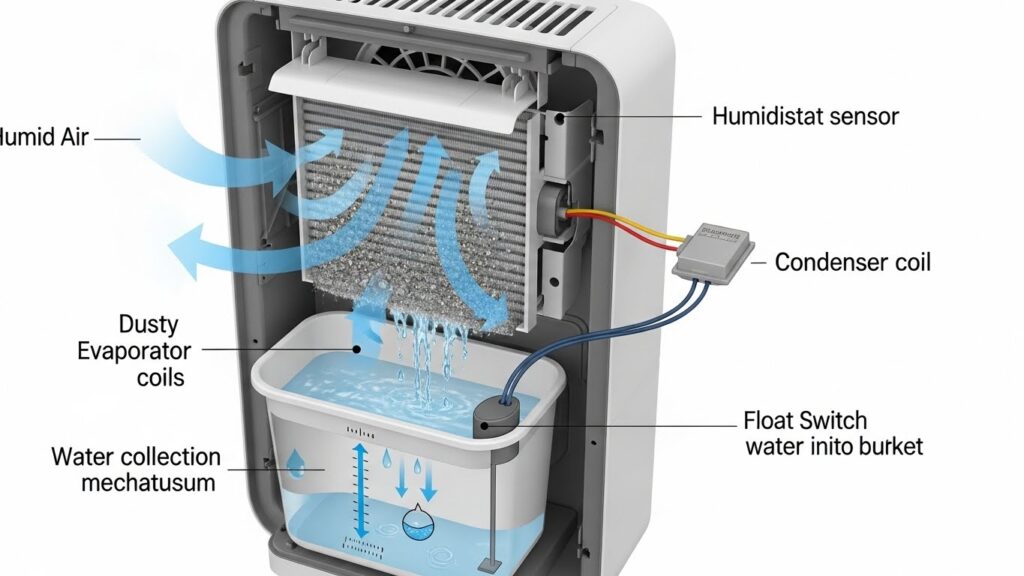
4) Bucket, float switch, and drainage issues
Bucket not seated correctly
If the bucket isn’t fully seated, many units refuse to dehumidify for safety. Reseat it firmly and listen for the “click” of the switch engaging (varies by model).
Float switch stuck (false “full bucket”)
A stuck float switch can stop water collection even with an empty bucket. Inspect the float mechanism for debris or misalignment. Move it gently to confirm it can travel freely.
Drain hose routing problems (if using continuous drain)
If you’re using a hose, make sure the hose slopes downward with no kinks. A small “uphill” loop can prevent drainage and confuse bucket/full behavior on some designs.
5) When it might be a real mechanical fault
After you confirm humidity and temperature are reasonable and airflow is strong, then it makes sense to consider a deeper fault. The goal here is not to “DIY sealed-system work,” but to identify when professional service is the next rational step.
Possible compressor not running (fan only)
If the fan runs but the dehumidifier never seems to enter a true dehumidifying cycle, the compressor circuit may not be engaging. Some models have a delay before the compressor starts, so give it time. If it never engages across multiple test cycles, it may require service.
Coil icing that repeats quickly
Light frost can occur in cooler rooms, but repeated heavy icing can block airflow and stop water flow completely. If icing happens quickly in a not-that-cold room, that’s a sign you may need professional diagnosis.
Stop-DIY moment: If you suspect sealed-system issues (refrigerant leak, compressor failure), do not attempt to open or pierce tubing. Sealed-system work is not a safe or cost-effective DIY path for most consumer units.
Signs the dehumidifier may be working normally
- Humidity is already near your target setting
- Room temperature is cool (especially basements in winter)
- Compressor cycles on and off normally, with no strange noises or repeated icing
In these cases, “no water right now” can simply mean there’s not much moisture available to condense.
FAQ
Q1) Should a dehumidifier always collect water?
No. If humidity is low or the room is cool, condensation can slow dramatically or stop. The unit may still be running normally.
Q2) Can a dirty filter really stop water collection?
Yes. Restricted airflow is one of the most common reasons a unit “runs” but doesn’t dehumidify effectively. Clean the filter first before suspecting a bigger failure.
Q3) What if the unit blows warm air but collects no water?
Warm exhaust can be normal during dehumidifying cycles, but if there’s still no water after confirming humidity, temperature, and airflow, then you may need deeper diagnosis (sensor, icing, compressor engagement).
Q4) Can a stuck “full bucket” sensor stop collection?
Yes. If the float switch is stuck or the bucket isn’t seated correctly, some models will stop the dehumidifying cycle.
Q5) When should I call a technician?
If humidity is clearly high, airflow is strong, the bucket switch is fine, and you still get no water—especially with unusual noises, repeated icing, or signs the compressor isn’t engaging.
Related Guides on HomeFix Atlas
- Humidifier White Dust — Causes and Prevention
- Portable AC Not Cooling — Airflow and Hose Fixes
- HomeFix Atlas — Appliance Troubleshooting Hub
References
Important Safety & YMYL Notice
Important: This content is provided for general informational purposes only. Dehumidifiers contain electrical components and (in many models) a sealed refrigerant system. Improper handling may cause damage or injury. If internal components require access or sealed-system faults are suspected, consult a qualified technician.
Update Log:
– January 10, 2026: Rebuilt the guide around the dew point model, added a fast reality checklist, expanded airflow + bucket-switch diagnostics, and clarified stop-DIY thresholds.

I publish step-by-step troubleshooting guides for common home appliance issues (washer, dryer, refrigerator, HVAC basics).
Content is written for everyday homeowners and cross-checked with manufacturer manuals, safety guidance, and trusted public resources.
Posts include practical checks, clear stop-signs for safety, and guidance on when it’s better to call a qualified technician. Updates are logged whenever steps or recommendations change.
Safety note: If you smell gas, see burning, or suspect electrical hazards—stop immediately and contact a qualified professional.