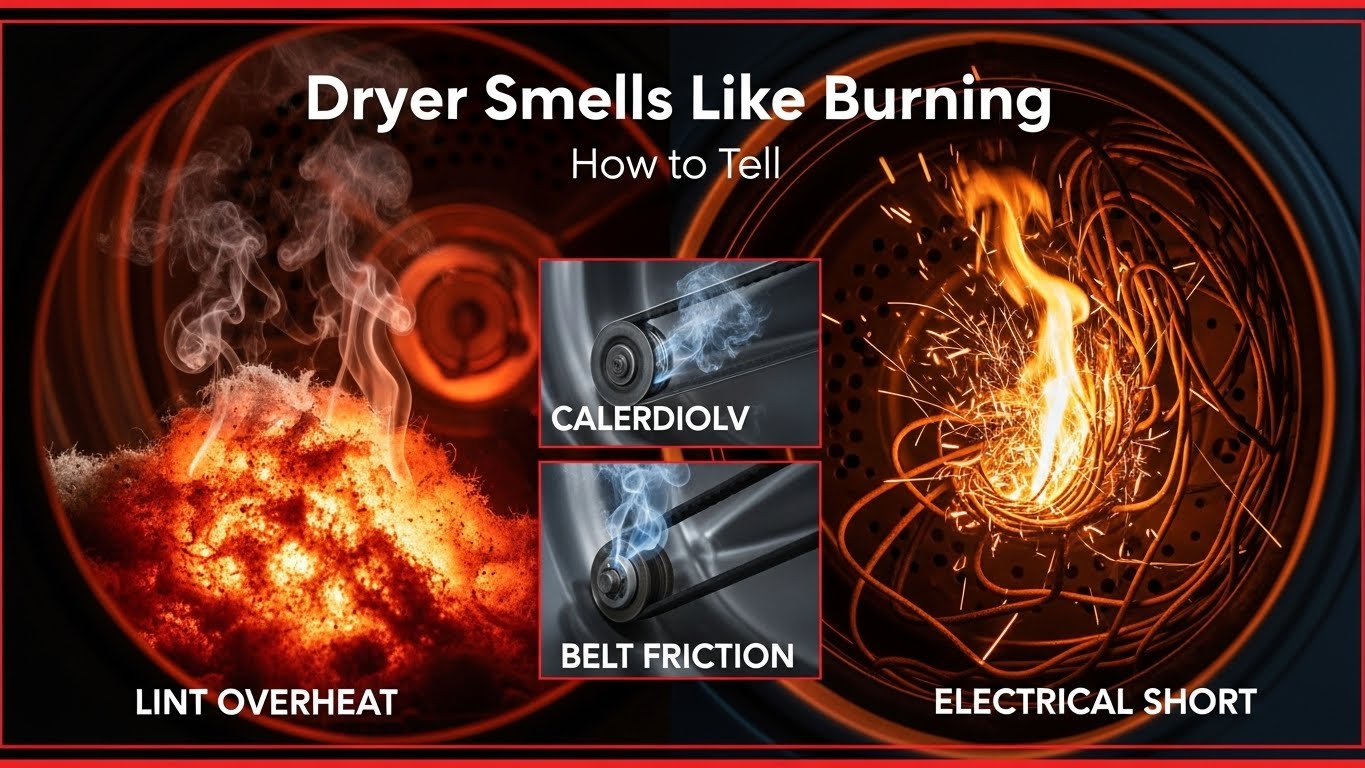
Dryer smells like burning? Treat it as an airflow + lint emergency first—then rule out electrical and friction faults.
“Burning smell” is a vague label. The real skill is classifying the odor (toasted lint vs rubber vs sharp electrical vs gas), then running a safe, priority protocol that proves what’s wrong—without parts roulette. This page is built like a one-page playbook: smell → risk level → next action.
2-minute truth testIf outside exhaust feels hot but weak, the dryer is overheating because it can’t breathe.
The “water bead” clueIf water beads on the lint screen, residue is choking airflow before the vent even matters.
Stop-now smellSharp/chemical “hot electronics” → unplug and don’t run it again until inspected.
What this page helps you do (end-to-end)
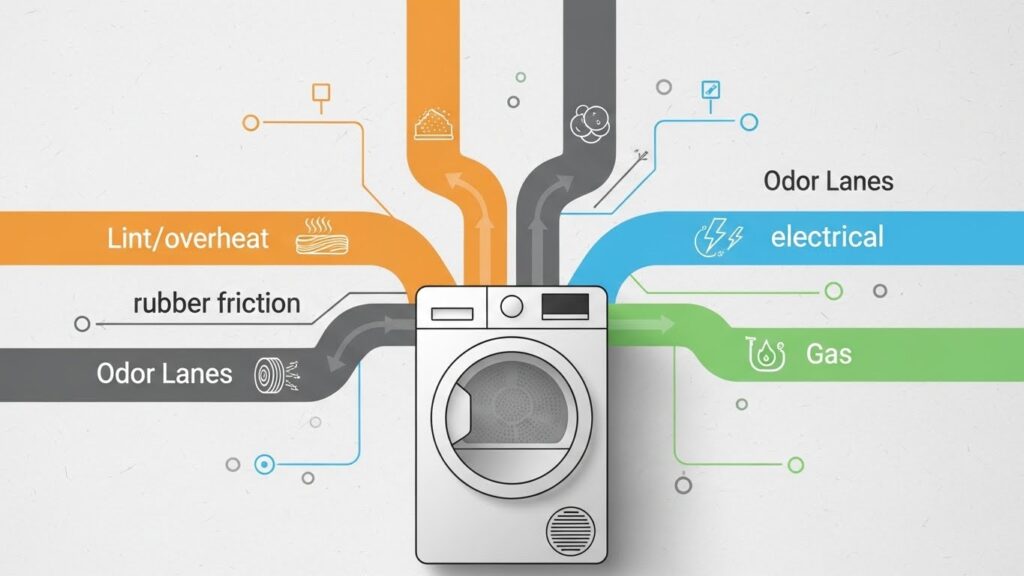
- Classify the odor into 4 buckets (lint/overheat, rubber friction, electrical, gas).
- Fix the highest-probability causes in the safest order (airflow first, then internals).
- Know exactly when DIY ends: red flags that deserve a pro immediately.
⚠️ Safety & Red Flags (do not “test another cycle”)
- Unplug first before pulling the dryer out or opening panels. Let it cool down.
- Stop immediately if you see smoke, scorching, melting plastic smell that returns fast, or repeated breaker trips.
- Sharp/chemical electrical odor (hot wiring / ozone-like) → unplug and do not run again until inspected.
- Gas dryer: if you smell gas (often “rotten egg” odorant), shut off the gas valve, ventilate, and follow local safety guidance.
Updated: 2026-01-22 • One-page triage + safe fix protocol • Electric + gas dryers (airflow-first)
A dryer is a heater that depends on airflow to stay sane. When airflow drops, heat doesn’t just “build up”—it concentrates in the places lint likes to hide. That’s why one load can smell “toasty” and the next can smell like hot rubber or even sharp electronics. The move is simple: name the smell, then follow the shortest path to a safe answer.
Why burning smells happen (the simplest explanation that actually predicts the outcome)
Inside your dryer, airflow does two jobs at once: it removes moisture and carries heat away from the heater area. If lint, crushed ducting, or a blocked outside hood slows the exhaust, the dryer runs hotter than intended and “bakes” dust/lint into a toasted smell. If airflow is fine but parts are rubbing or wiring is overheating, the smell shifts—rubbery or sharp/chemical.
The physics in one line
When airflow drops, internal heat rises faster: Heat Build-Up ∝ (Heater Output) ÷ (Airflow)
Olfactory diagnostic (what you smell → what it usually is → safest first action)
| Smell “type” | Most common meaning | Best first move | Risk level |
|---|---|---|---|
| Toasty / hot dust / hot lint | Airflow restriction + lint heating up (vent/hood/duct path) | Outside hood airflow test + vent path inspection/clean | Moderate |
| Rubbery / friction / “hot belt” | Belt slipping, idler pulley drag, roller issue, overloaded drum | Stop → listen for squeal/scrape → inspect drum movement | Low–Medium |
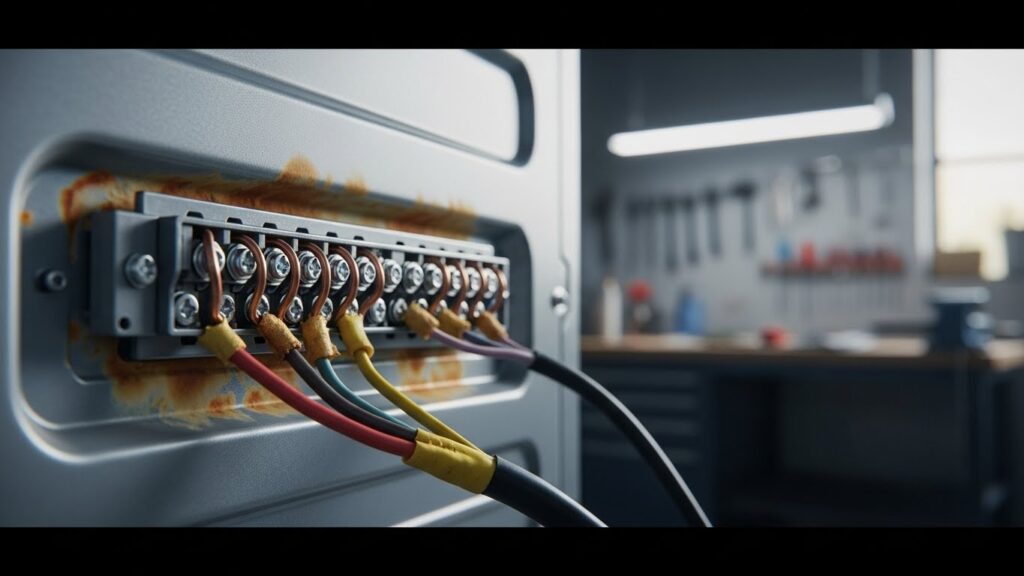
| Sharp / chemical / hot electronics | Electrical overheating (terminal block, wiring, control board) | Unplug immediately; do not run again until inspected | High |
| Gas odor (gas dryers) | Possible gas leak / burner issue | Shut off gas; ventilate; follow local guidance | Critical |
Priority Fix Protocol (5 steps, safest order)
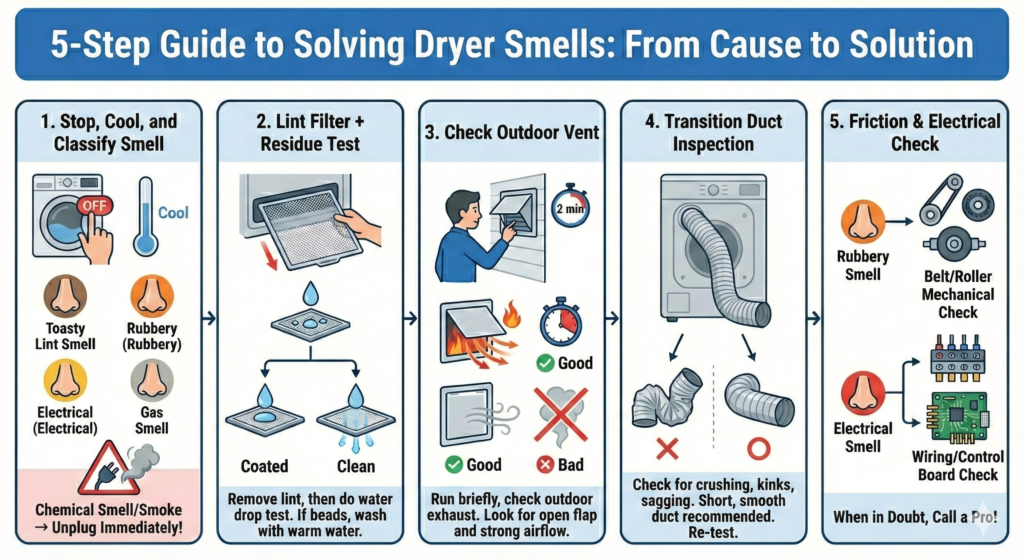
- Step 1 — Stop, cool, and classify the smell:
Turn the dryer off and let it cool. Don’t keep running it “to confirm.”
Decide the smell lane: toasty lint vs rubbery friction vs sharp electrical vs gas.
If the smell is sharp/chemical or you see smoke → unplug and stop (skip to Serious Cases). - Step 2 — Fix the easiest airflow choke: lint screen + residue check:
Remove lint, then do the quick residue test: drip water on the screen.
If water beads instead of flowing through, wash the screen with warm water and a soft brush, then dry fully.
A coated screen can restrict airflow enough to raise heat and create “toasty” odors. - Step 3 — The outside hood “truth test” (2 minutes that saves hours):
Run the dryer briefly on a timed cycle, then go outside.
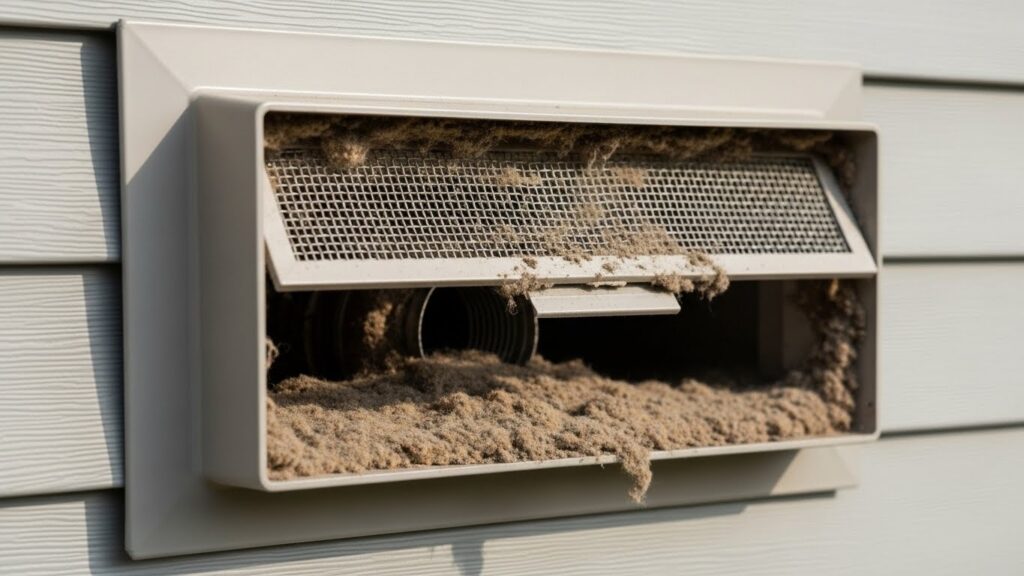
You want a flap that opens freely and steady exhaust you can feel.
If exhaust is hot but weak, treat it like a restriction: clear lint mats, remove debris, and plan a full vent-path clean. - Step 4 — Inspect the transition duct behind the dryer (the hidden choke point):
Unplug; pull the dryer out carefully. Look for crushed, kinked, sagging, or overly long flex ducting.
Shorter and smoother beats long “accordion” runs. Confirm tight connections (no gaps blowing lint indoors).
Re-test outside airflow afterward—this is your proof, not your guess. - Step 5 — If airflow is good, move to friction and electrical checks (don’t mix lanes):
Rubbery smell + squeal/scrape often points to belt/idler/roller drag—stop and inspect mechanical movement.
Sharp electrical smell points to terminal block/wiring/control board—do not keep “trial running.”
Advanced (only if comfortable): a technician may use a multimeter to check for unsafe electrical faults; when in doubt, service is safer.
Pro-tip that prevents repeat scares
Don’t judge success by “the smell went away once.” Judge it by outside airflow improving and the smell not returning quickly. Borderline airflow can look fine on light loads and fail on heavy towels.
Diagnostic matrix (what’s happening → best next move)
| Scenario | Most likely direction | Do this next | Stop now? |
|---|---|---|---|
| Toasty smell + long dry times | Airflow restriction / lint heating | Outside hood test + vent path clean + duct de-kink | If smell intensifies |
| Toasty smell + weak outside exhaust | Blocked hood / crushed duct / heavy lint in vent | Fix venting before any more cycles | Yes |
| Rubbery smell + squeal/scrape | Friction/drag (belt/idler/roller) | Stop; inspect movement; service if unsure | If smoke or worsening noise |
| Sharp electrical smell at any time | Electrical overheating risk | Unplug; do not run until inspected | Yes |
| Brand-new dryer mild warm odor | Break-in / oils/residue burning off | Short run; monitor; confirm vent routing is correct | If smoky, sharp, or persistent |
Timing plan (do the right thing in the right window)
| Time you have | Do this | Goal |
|---|---|---|
| 1–2 minutes | Stop; unplug; ventilate the area; let it cool | Reduce risk immediately |
| 5–10 minutes | Lint screen clean + water bead test + outside hood check | Confirm airflow-lane quickly |
| 20–40 minutes | Pull dryer out; fix crushed/kinked transition duct; re-test exhaust | Remove the most common choke point |
| 45–90 minutes | Clean full vent path (brush kit/vacuum) or schedule professional cleaning | Restore safe exhaust flow |
Common mistakes (that make burning smells worse)
- Running “one more cycle” to finish the load: borderline airflow becomes an overheating event.
- Cleaning only the lint screen: lint that escaped the screen can sit in ducting and heater areas.
- Using long, sagging flex duct: sags trap lint and create hot spots.
- Ignoring sharp electrical smells: that lane is unplug-first, not trial-and-error.
Quick win checklist (printable in your head)
- Outside hood flap opens freely + strong exhaust
- Transition duct behind dryer is short, smooth, not crushed
- Lint screen passes water (no waxy residue)
- No sharp electrical odor, no scorching, no smoke
Serious cases (stop and get qualified help)
Stop immediately if you notice smoke, visible scorching, melting insulation smell that returns quickly, repeated breaker trips, harsh scraping noises with heat, or any sharp electrical/chemical odor. For gas dryers, any persistent gas odor is a stop-now situation.
FAQ
Why does my dryer smell like burning only sometimes?
Intermittent smells often happen when airflow is borderline. Heavy loads (towels, bedding) push the system over the edge. The outside hood airflow check is the fastest way to confirm.
Is a burning smell normal on a new dryer?
A mild warm “break-in” odor can happen for the first few cycles as residues burn off. It should not be sharp, smoky, or increasing. If it persists, confirm correct vent routing and airflow.
Can a clogged vent cause a burning smell even if the dryer still dries?
Yes. A dryer can still dry while running hotter than it should, especially on timed cycles. Restricted exhaust traps heat and creates hot-lint odor.
What does an electrical burning smell from a dryer seem like?
People often describe it as sharp, chemical, or “hot electronics.” If you suspect that smell, unplug and don’t keep testing.
Do dryer sheets contribute to burning smells?
Indirectly, yes. Some sheets leave residue on the lint screen, reducing airflow. Use the water bead test—if it beads, wash the screen and dry it fully.
How often should I clean the dryer vent?
If dry times increase or you notice heat/burning odors, treat it as “clean now.” Long vents, multiple turns, pets, and heavy use often need more frequent attention.
Internal Links
- https://homefixatlas.com/dryer-not-heating/ — Use this if the dryer runs but you’re not getting real heat at all
- https://homefixatlas.com/dryer-not-heating-2/ — A deeper no-heat checklist (fuse/igniter-style logic depending on model)
- https://homefixatlas.com/dryer-making-loud-noises/ — If you hear squealing, scraping, or rumbling that hints at belt/roller drag
Sources & References
- NFPA: Clothes Dryer Safety Tip Sheet
- U.S. CPSC: Overheated Clothes Dryers Can Cause Fires (PDF)
- PNNL Building America: Proper Clothes Dryer Venting
Professional disclaimer
This guide is informational and focuses on safe airflow/lint-risk diagnostics. If you suspect electrical overheating, see smoke/scorching, have repeated breaker trips, or notice any gas odor concerns, stop use and consult a qualified technician or licensed professional.
Update log: 2026-01-22 — Unified odor-classification + airflow truth test + stop-now decision points, expanded matrices and timing plan, and added authoritative safety sources.

I publish step-by-step troubleshooting guides for common home appliance issues (washer, dryer, refrigerator, HVAC basics).
Content is written for everyday homeowners and cross-checked with manufacturer manuals, safety guidance, and trusted public resources.
Posts include practical checks, clear stop-signs for safety, and guidance on when it’s better to call a qualified technician. Updates are logged whenever steps or recommendations change.
Safety note: If you smell gas, see burning, or suspect electrical hazards—stop immediately and contact a qualified professional.