Washer making grinding noise? Do the empty-spin test first—then decide “safe to run” vs “stop now.”
Grinding can be load-related (pocket item, imbalance, something rubbing under weight) or a machine-related mechanical problem. The fastest separator is simple: Does it grind with the drum empty?
Fast path (2–5 minutes, no tools)
- Pause → remove all laundry (check pockets / remove any loose coins).
- Run “Spin Only” (or “Rinse & Spin”) with the drum empty.
- If grinding stays while empty: stop using it and move to the “Stop-now” checks below.
Rule of thumb: quiet when empty = often load/foreign object/leveling. noisy when empty = mechanical friction (don’t keep running it).
⚠️ Safety & “Stop Now” signals
- Unplug before any inspection near hoses, panels, or the underside.
- Stop immediately if you smell burning, see sparks/arcing, or the plug/outlet feels hot.
- Stop if it keeps tripping the breaker or you feel any shock/tingle.
- Stop if grinding continues with no load (that’s a mechanical/damage risk, not “just noise”).
Updated: 2026-01-17 • Plain-English diagnostics • Built for safe, non-invasive troubleshooting
That grinding sound is the kind of noise that makes you freeze mid-step. I get it. But here’s the problem: some washers have “mechanical” drive sounds that are normal, while a true grind can chew parts fast. The goal of this guide is to help you classify the sound and run a quick empty-drum test so you stop guessing.
You don’t need fancy tools for the first pass. You just need to answer three questions: (1) When does it happen? (2) Does it happen with no load? (3) Is there any safety red flag?
Jump to
1) Sound map: what “grinding” usually is
2) The decision tree (empty-spin first)
3) 7-step safe diagnostic protocol
4) Diagnostic matrix + timeline
5) Common mistakes that make it worse
6) FAQ
Internal Links
Sources & References
1) Sound map: what “grinding” usually is (simple, not scary)
“Grinding” is a label people use for a few different sounds. Before you do anything, try to match your noise to one of these buckets: rubbing (friction), scraping (foreign object), banging (imbalance/impact), or drive engagement (some normal mechanical sounds).
| Sound clue | Most likely cause bucket | Best first move |
|---|---|---|
| Rhythmic scraping (tick…tick…) | Foreign object (coin, wire, zipper pull) | Empty-spin test + flashlight check at seal/drum holes |
| Low “gravelly” grind, even when empty | Mechanical friction (bearings/drive parts) | Stop running → manual drum feel test (power off) |
| Loud banging that people call “grinding” | Imbalance / washer rocking / heavy single item | Rebalance load + leveling/rocking check |
| Noise + burning smell / hot plug / breaker trip | Electrical hazard risk | Unplug and stop testing |
2) The decision tree (this prevents expensive guessing)
Start here:
- Any safety red flag? (burning smell, sparks, hot outlet, shock/tingle, breaker trips) → Unplug and stop.
- Run the empty-spin test. Grinding with empty drum → Stop running; treat as mechanical friction.
- Grinding only with laundry inside? → likely foreign object / imbalance / leveling. Continue with the safe protocol below.
Why the empty-spin test works
When the drum is empty, you remove “laundry variables.” If the sound stays, the washer is creating it on its own—usually friction or a failing drive/support component. If it disappears, the weight and movement of laundry is triggering the problem.
3) 7-step safe diagnostic protocol (no invasive teardown)
- Confirm the phase (60 seconds):
Does it happen during wash/agitation, drain, or spin?
If it’s only during spin, load/leveling becomes a top suspect—but bearings can also show up here. - Empty-spin test (2–6 minutes):
Run Spin Only (or Rinse & Spin) with the drum empty.
If grinding is still there: stop running it and skip to Step 6 + “When to stop.” - Pocket / hardware reality check (2 minutes):
Coins, screws, bra wires, and zippers can sound brutal.
Check pockets and look around the door seal area for anything trapped. - Small balanced test load (10–15 minutes):
Use a small mix (a few towels). Avoid one heavy item alone.
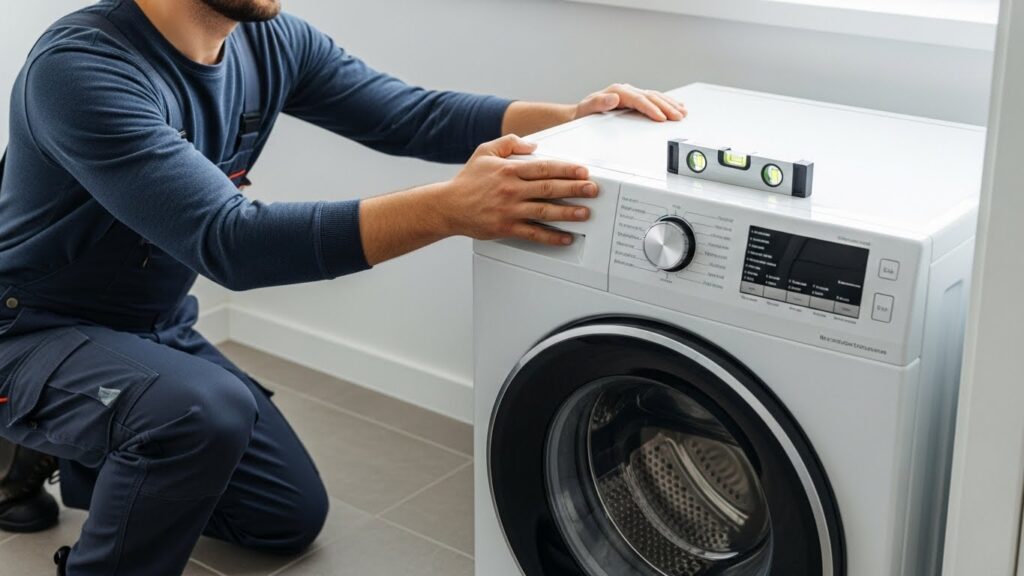
If the sound appears only with one bulky item, it’s likely imbalance/impact. - Rocking / leveling check (30 seconds):
Push gently on the front corners—does it rock?
A rocking washer can turn mild drive sounds into something that feels like grinding. - Manual drum feel test (power off):
Unplug. Slowly rotate the drum by hand.
It should feel smooth. If it feels like it’s “rolling over gravel” or you feel catching resistance, treat it as mechanical friction. - Drain-phase clue (if it grinds while draining):
If the noise lines up with water leaving the tub, a small object may be in the drain path/pump area.
Don’t keep cycling it—repeated grinding can damage the impeller or housing.
4) Diagnostic matrix (symptom → safest next step)
| Symptom | What it suggests | Safest next action | Avoid |
|---|---|---|---|
| Grinding only with heavy loads | Imbalance/impact or rubbing under weight | Small balanced load + leveling check | Testing again with the same bulky item |
| Grinding continues when empty | Mechanical friction (bearing/drive/support) | Stop running; manual drum feel test; service planning | Repeated cycles “to confirm” |
| Grinding + water leak | Damage + safety risk | Unplug, stop, inspection recommended | Operating with leaks near power |
| Grinding + burning smell/hot outlet/breaker trips | Electrical hazard risk | Shut down power and stop | “One more load” gambling |
The troubleshooting timeline (fast checks first)
| Check | Time | What it proves |
|---|---|---|
| Empty-spin test | 2–6 min | Load-related vs machine-related noise. |
| Rocking / leveling push test | 30 sec | Whether vibration is amplifying the sound. |
| Manual drum feel (unplugged) | 1 min | Catching/gravel feel suggests mechanical friction. |
5) Common mistakes (and why they backfire)
- Running it repeatedly “to confirm”: if it’s friction, you can accelerate wear fast.
- Testing with the same heavy blanket again: one bulky item can trigger severe imbalance and impact noise.
- Ignoring the empty-spin result: grinding while empty is not a “laundry” issue.
- Chasing parts too early: do the pocket/foreign-object and leveling checks before assuming major failure.
- Powering through safety signs: burning smell, hot outlet, sparks, breaker trips = stop.
FAQ
Can a washer make grinding noises and still be “normal”?
Sometimes, yes. Some designs have mechanical drive sounds that people describe as grind-y. The safer rule is: if the sound is new, sharp/metallic, worsening, or happens with an empty drum, treat it as a stop-and-check issue.
Why does it grind only during spin?
Spin amplifies force and vibration. A small imbalance or a washer that rocks can create impact noise that feels like grinding. Try a small balanced load and confirm the washer is stable.
Grinding started after washing items with zippers or coins—does that matter?
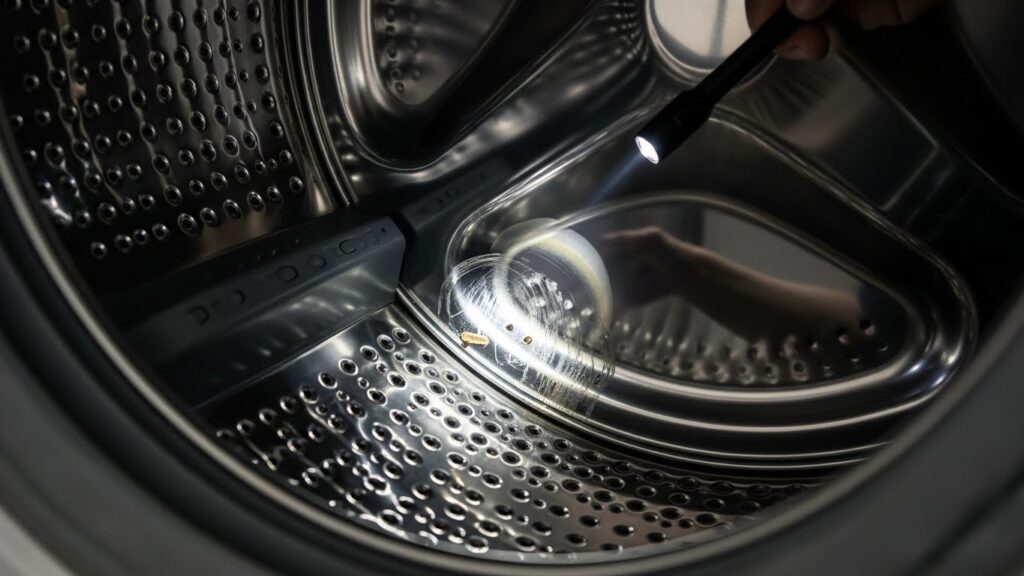
Yes. Small hard objects can get trapped and scrape. Do the empty-spin test first, then use a flashlight around the door seal and drum openings.
If it grinds while empty, what’s the smart move?
Stop running it and avoid “one more test.” Unplug, do a gentle manual drum feel check, and plan inspection/service if it feels rough or catches.
What if the grinding happens during draining?
If the sound lines up with water leaving the tub, a small object may be in the drain path/pump area. Repeated cycles can damage parts—don’t keep running it “until it clears.”
What are the “stop now” signs again?
Burning smell, sparks/arcing, hot outlet/plug, breaker trips, shock/tingle, water leak near power, or grinding that continues with an empty drum.
Internal Links
https://homefixatlas.com/washer-shaking-or-vibrating/
https://homefixatlas.com/washer-leaves-detergent-residue/
https://homefixatlas.com/washer-not-draining-fix-guide/
Sources & References
- Whirlpool Product Help: Grinding or Rubbing Noise (Washer)
- Sears PartsDirect: Washer makes grinding noise during agitation — what it can mean
- U.S. CPSC: Plug into electrical safety (breaker trips / shock guidance)
Professional disclaimer
This article is educational and focuses on safe, non-invasive checks. If you observe electrical danger signs (sparks, burning smell, hot outlet/plug), repeated breaker trips, shock/tingle, leaks near power, or grinding that persists with an empty drum, unplug the washer and consult a qualified technician.
Update log
2026-01-17 — Rebuilt decision-tree around empty-spin test, expanded symptom matrix, added safer stop-now criteria, and improved sound classification for faster DIY triage.

I publish step-by-step troubleshooting guides for common home appliance issues (washer, dryer, refrigerator, HVAC basics).
Content is written for everyday homeowners and cross-checked with manufacturer manuals, safety guidance, and trusted public resources.
Posts include practical checks, clear stop-signs for safety, and guidance on when it’s better to call a qualified technician. Updates are logged whenever steps or recommendations change.
Safety note: If you smell gas, see burning, or suspect electrical hazards—stop immediately and contact a qualified professional.